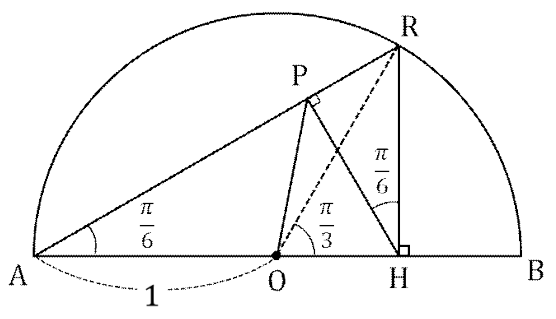
+10점 · 선분 A P ‾ \displaystyle \overline{\mathrm{AP}} AP +20점 · O P ‾ 2 + B P ‾ 2 \displaystyle \overline{\mathrm{OP}}^{2}+\overline{\mathrm{BP}}^{2} OP 2 + BP 2 1. 오른쪽 그림에서 A R ‾ 2 = 1 2 + 1 2 − 2 × 1 × 1 × cos 2 π 3 = 3 \displaystyle \overline{\mathrm{AR}}^{2}=1^{2}+1^{2}-2\times1\times1\times\cos\frac{2\pi}{3}=3 AR 2 = 1 2 + 1 2 − 2 × 1 × 1 × cos 3 2 π = 3 A R ‾ = 3 , R H ‾ = 3 2 , P R ‾ = 3 4 \displaystyle \overline{\mathrm{AR}}=\sqrt{3},\ \overline{\mathrm{RH}}=\frac{\sqrt{3}}{2},\ \overline{\mathrm{PR}}=\frac{\sqrt{3}}{4} AR = 3 , RH = 2 3 , PR = 4 3 이고 따라서 A P ‾ = 3 − 3 4 = 3 4 3 \displaystyle \overline{\mathrm{AP}}=\sqrt{3}-\frac{\sqrt{3}}{4}=\frac{3}{4}\sqrt{3} AP = 3 − 4 3 = 4 3 3
O P ‾ 2 = A P ‾ 2 + O A ‾ 2 − 2 A P ‾ × O A ‾ × cos π 6 = ( 3 4 3 ) 2 + 1 2 − 2 × 3 4 3 × 1 × 3 2 = 7 16 \displaystyle \overline{\mathrm{OP}}^{2}=\overline{\mathrm{AP}}^{2}+\overline{\mathrm{OA}}^{2}-2\overline{\mathrm{AP}}\times\overline{\mathrm{OA}}\times\cos\frac{\pi}{6}=\left(\frac{3}{4}\sqrt{3}\right)^{2}+1^{2}-2\times\frac{3}{4}\sqrt{3}\times1\times\frac{\sqrt{3}}{2}=\frac{7}{16} OP 2 = AP 2 + OA 2 − 2 AP × OA × cos 6 π = ( 4 3 3 ) 2 + 1 2 − 2 × 4 3 3 × 1 × 2 3 = 16 7 B P ‾ 2 = A P ‾ 2 + A B ‾ 2 − 2 A P ‾ × A B ‾ × cos π 6 = ( 3 4 3 ) 2 + 2 2 − 2 × 3 4 3 × 2 × 3 2 = 19 16 \displaystyle \overline{\mathrm{BP}}^{2}=\overline{\mathrm{AP}}^{2}+\overline{\mathrm{AB}}^{2}-2\overline{\mathrm{AP}}\times\overline{\mathrm{AB}}\times\cos\frac{\pi}{6}=\left(\frac{3}{4}\sqrt{3}\right)^{2}+2^{2}-2\times\frac{3}{4}\sqrt{3}\times2\times\frac{\sqrt{3}}{2}=\frac{19}{16} BP 2 = AP 2 + AB 2 − 2 AP × AB × cos 6 π = ( 4 3 3 ) 2 + 2 2 − 2 × 4 3 3 × 2 × 2 3 = 16 19 따라서 O P ‾ 2 + B P ‾ 2 = 7 16 + 19 16 = 13 8 \displaystyle \overline{\mathrm{OP}}^{2}+\overline{\mathrm{BP}}^{2}=\frac{7}{16}+\frac{19}{16}=\frac{13}{8} OP 2 + BP 2 = 16 7 + 16 19 = 8 13 답 : 13 8 \displaystyle \frac{13}{8} 8 13
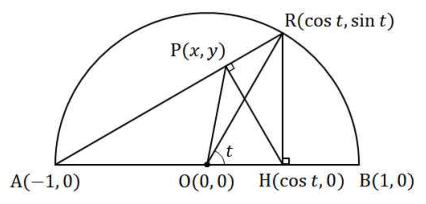
+20점 · O P ‾ \displaystyle \overline{\mathrm{OP}} OP +20점 · O P ‾ \displaystyle \overline{\mathrm{OP}} OP 2. 지름의 양 끝점이 A ( − 1 , 0 ) , B ( 1 , 0 ) \displaystyle \mathrm{A}(-1,0),\ \mathrm{B}(1,0) A ( − 1 , 0 ) , B ( 1 , 0 ) x \displaystyle x x ∠ R O B = t \displaystyle \angle\mathrm{ROB}=t ∠ ROB = t 0 ≤ t ≤ π \displaystyle 0\le t\le\pi 0 ≤ t ≤ π R ( cos t , sin t ) , H ( cos t , 0 ) \displaystyle \mathrm{R}(\cos t,\sin t),\ \mathrm{H}(\cos t,0) R ( cos t , sin t ) , H ( cos t , 0 )
0 < t < π \displaystyle 0<t<\pi 0 < t < π A ( − 1 , 0 ) , R ( cos t , sin t ) \displaystyle \mathrm{A}(-1,0),\ \mathrm{R}(\cos t,\sin t) A ( − 1 , 0 ) , R ( cos t , sin t ) y − 0 = sin t − 0 cos t − ( − 1 ) ( x − ( − 1 ) ) \displaystyle y-0=\frac{\sin t-0}{\cos t-(-1)}(x-(-1)) y − 0 = cos t − ( − 1 ) sin t − 0 ( x − ( − 1 )) 이고, 점 H를 지나고 선분 AR에 수직인 직선의 방정식은 y − 0 = − 1 + cos t sin t ( x − cos t ) \displaystyle y-0=-\frac{1+\cos t}{\sin t}(x-\cos t) y − 0 = − sin t 1 + cos t ( x − cos t ) 이다. 점 P는 이 두 직선의 교점이므로 두 직선의 방정식을 연립해서 풀면, 점 P ( x , y ) \displaystyle \mathrm{P}(x,y) P ( x , y ) { x = 1 2 ( cos 2 t + 2 cos t − 1 ) y = 1 2 sin t ( 1 + cos t ) \displaystyle \begin{cases}x=\frac{1}{2}(\cos^{2}t+2\cos t-1)\\y=\frac{1}{2}\sin t(1+\cos t)\end{cases} { x = 2 1 ( cos 2 t + 2 cos t − 1 ) y = 2 1 sin t ( 1 + cos t ) t = 0 \displaystyle t=0 t = 0 t = π \displaystyle t=\pi t = π 따라서 O P ‾ = x 2 + y 2 = ( 1 2 ( cos 2 t + 2 cos t − 1 ) ) 2 + ( 1 2 sin t ( 1 + cos t ) ) 2 = 1 2 ( cos 3 t + cos 2 t − cos t + 1 ) \displaystyle \begin{aligned}\overline{\mathrm{OP}}&=\sqrt{x^{2}+y^{2}}=\sqrt{\left(\frac{1}{2}(\cos^{2}t+2\cos t-1)\right)^{2}+\left(\frac{1}{2}\sin t(1+\cos t)\right)^{2}}\\&=\sqrt{\frac{1}{2}(\cos^{3}t+\cos^{2}t-\cos t+1)}\end{aligned} OP = x 2 + y 2 = ( 2 1 ( cos 2 t + 2 cos t − 1 ) ) 2 + ( 2 1 sin t ( 1 + cos t ) ) 2 = 2 1 ( cos 3 t + cos 2 t − cos t + 1 ) 이고, f ( t ) = cos 3 t + cos 2 t − cos t + 1 \displaystyle f(t)=\cos^{3}t+\cos^{2}t-\cos t+1 f ( t ) = cos 3 t + cos 2 t − cos t + 1 f ′ ( t ) = − sin t ( cos t + 1 ) ( 3 cos t − 1 ) \displaystyle f^{\prime}(t)=-\sin t(\cos t+1)(3\cos t-1) f ′ ( t ) = − sin t ( cos t + 1 ) ( 3 cos t − 1 ) 0 ≤ t ≤ π \displaystyle 0\le t\le\pi 0 ≤ t ≤ π − 1 ≤ cos t ≤ 1 \displaystyle -1\le\cos t\le1 − 1 ≤ cos t ≤ 1 오른쪽 표에서 f ( t ) \displaystyle f(t) f ( t ) t = α , cos α = 1 3 \displaystyle t=\alpha,\ \cos\alpha=\frac{1}{3} t = α , cos α = 3 1 f ( t ) = 22 27 \displaystyle f(t)=\frac{22}{27} f ( t ) = 27 22 t 0 ⋯ α ⋯ π cos t 1 ⋯ 1 3 ⋯ − 1 f ′ ( t ) 0 − 0 + 0 f ( t ) 2 ↘ 22 27 ↗ 2 \displaystyle \begin{array}{c|c|c|c|c|c}t&0&\cdots&\alpha&\cdots&\pi\\\hline\cos t&1&\cdots&\frac{1}{3}&\cdots&-1\\\hline f^{\prime}(t)&0&-&0&+&0\\\hline f(t)&2&\searrow&\frac{22}{27}&\nearrow&2\end{array} t cos t f ′ ( t ) f ( t ) 0 1 0 2 ⋯ ⋯ − ↘ α 3 1 0 27 22 ⋯ ⋯ + ↗ π − 1 0 2 따라서 구하는 O P ‾ \displaystyle \overline{\mathrm{OP}} OP 1 2 × 22 27 = 11 3 3 = 33 9 \displaystyle \sqrt{\frac{1}{2}\times\frac{22}{27}}=\frac{\sqrt{11}}{3\sqrt{3}}=\frac{\sqrt{33}}{9} 2 1 × 27 22 = 3 3 11 = 9 33 답 : 33 9 \displaystyle \frac{\sqrt{33}}{9} 9 33
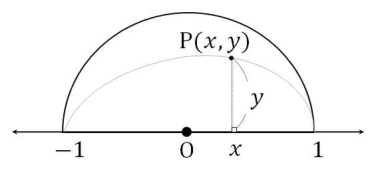
+20점 · 정사각형의 한 변의 길이인 y \displaystyle y y y 2 \displaystyle y^{2} y 2 x \displaystyle x x +10점 · 주어진 입체의 부피를 구했는가? 3. 2번에서 구한 P ( x , y ) \displaystyle \mathrm{P}(x,y) P ( x , y ) cos t = − 1 + 2 + 2 x \displaystyle \cos t=-1+\sqrt{2+2x} cos t = − 1 + 2 + 2 x y 2 = ( 1 2 sin t ( 1 + cos t ) ) 2 = 1 4 ( 1 − cos t ) ( 1 + cos t ) 3 = 1 4 ( 2 − 2 + 2 x ) ( 2 + 2 x ) 3 = 2 ( 1 + x ) 3 2 − ( 1 + x ) 2 \displaystyle \begin{aligned}y^{2}&=\left(\frac{1}{2}\sin t(1+\cos t)\right)^{2}=\frac{1}{4}(1-\cos t)(1+\cos t)^{3}\\&=\frac{1}{4}(2-\sqrt{2+2x})(\sqrt{2+2x})^{3}=\sqrt{2}(1+x)^{\frac{3}{2}}-(1+x)^{2}\end{aligned} y 2 = ( 2 1 sin t ( 1 + cos t ) ) 2 = 4 1 ( 1 − cos t ) ( 1 + cos t ) 3 = 4 1 ( 2 − 2 + 2 x ) ( 2 + 2 x ) 3 = 2 ( 1 + x ) 2 3 − ( 1 + x ) 2 이다. − 1 ≤ x ≤ 1 \displaystyle -1\le x\le1 − 1 ≤ x ≤ 1
∫ − 1 1 y 2 d x = ∫ − 1 1 2 ( 1 + x ) 3 2 d x − ∫ − 1 1 ( 1 + x ) 2 d x = [ 2 2 5 ( 1 + x ) 5 2 − 1 3 ( 1 + x ) 3 ] − 1 1 = 8 15 \displaystyle \begin{aligned}\int_{-1}^{1}y^{2}\,dx&=\int_{-1}^{1}\sqrt{2}(1+x)^{\frac{3}{2}}\,dx-\int_{-1}^{1}(1+x)^{2}\,dx\\&=\Biggl[\frac{2\sqrt{2}}{5}(1+x)^{\frac{5}{2}}-\frac{1}{3}(1+x)^{3}\Biggr]_{-1}^{1}=\frac{8}{15}\end{aligned} ∫ − 1 1 y 2 d x = ∫ − 1 1 2 ( 1 + x ) 2 3 d x − ∫ − 1 1 ( 1 + x ) 2 d x = [ 5 2 2 ( 1 + x ) 2 5 − 3 1 ( 1 + x ) 3 ] − 1 1 = 15 8 이다. 답 : 8 15 \displaystyle \frac{8}{15} 15 8
 수리논술, 배움에서 논증의 완성까지.