수리논술, 배움에서 논증의 완성까지.

의·약학계 2번

문제

🔒
짧은 시간에 너무 많은 문제를 여셔서 열람을 잠시 제한했습니다. 잠시 후 다시 시도하시거나 로그인해 주세요.
해설강의 준비중
+5점 · 사인법칙에 의해 CEsin(CDE)=ABsin(ADB)=2R\displaystyle \frac{\overline{\mathrm{CE}}}{\sin(\angle\mathrm{CDE})}=\frac{\overline{\mathrm{AB}}}{\sin(\angle\mathrm{ADB})}=2R가 성립함을 나타낼 수 있다.

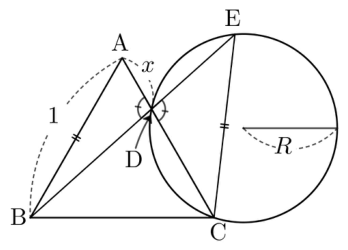
[2-1]ADB\displaystyle \angle\mathrm{ADB}CDE\displaystyle \angle\mathrm{CDE}는 맞꼭지각으로 서로 같고, 주어진 조건에 의해 AB=CE=1\displaystyle \overline{\mathrm{AB}}=\overline{\mathrm{CE}}=1이다.CDE\displaystyle \triangle\mathrm{CDE}의 외접원의 반지름의 길이를 R\displaystyle R라 하면 사인법칙에 의해CEsin(CDE)=ABsin(ADB)=2R\displaystyle \frac{\overline{\mathrm{CE}}}{\sin(\angle\mathrm{CDE})}=\frac{\overline{\mathrm{AB}}}{\sin(\angle\mathrm{ADB})}=2R이므로 ADB\displaystyle \triangle\mathrm{ADB}의 외접원의 반지름의 길이도 R\displaystyle R이다.

삼각형 CDE와 ADB의 외접원
+5점 · BD=x2x+1\displaystyle \overline{\mathrm{BD}}=\sqrt{x^2-x+1}로 나타낼 수 있다.

또한 AD=x  (0<x<1)\displaystyle \overline{\mathrm{AD}}=x\;(0<x<1)라 하면 코사인법칙에 의해 BD2=x2+122xcosπ3=x2x+1\displaystyle \overline{\mathrm{BD}}^2=x^2+1^2-2x\cos\frac\pi3=x^2-x+1이다.즉, BD=x2x+1\displaystyle \overline{\mathrm{BD}}=\sqrt{x^2-x+1}이다.

+5점 · R=x2x+13\displaystyle R=\sqrt{\frac{x^2-x+1}3}로 나타낼 수 있다.

사인법칙에 의해 BDsin(BAD)=BDsinπ3=x2x+132=2R\displaystyle \frac{\overline{\mathrm{BD}}}{\sin(\angle\mathrm{BAD})}=\frac{\overline{\mathrm{BD}}}{\sin\frac\pi3}=\frac{\sqrt{x^2-x+1}}{\frac{\sqrt3}2}=2R이므로 R=x2x+13\displaystyle R=\sqrt{\frac{x^2-x+1}3}이다.

+6점 · DE=x(2x)x2x+1\displaystyle \overline{\mathrm{DE}}=\frac{x(2-x)}{\sqrt{x^2-x+1}}로 나타낼 수 있다.

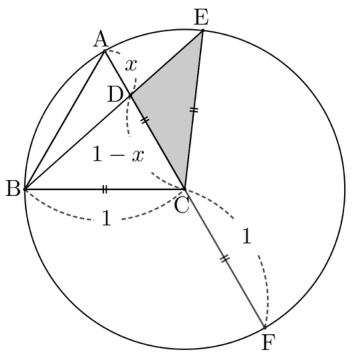
[2-2]CB=CA=CE=1\displaystyle \overline{\mathrm{CB}}=\overline{\mathrm{CA}}=\overline{\mathrm{CE}}=1이므로 점 A, 점 B, 점 E는 모두 점 C를 중심으로 하는 반지름의 길이가 1\displaystyle 1인 원 위의 점이다.직선 AC가 이 원과 만나는 점 중 A가 아닌 점을 F라 하자.AD=x  (0<x<1)\displaystyle \overline{\mathrm{AD}}=x\;(0<x<1)라 하면 CD=1x\displaystyle \overline{\mathrm{CD}}=1-x이므로 DF=2x\displaystyle \overline{\mathrm{DF}}=2-x이다.따라서 AD×DF=BD×DE\displaystyle \overline{\mathrm{AD}}\times\overline{\mathrm{DF}}=\overline{\mathrm{BD}}\times\overline{\mathrm{DE}}이므로 DE=x(2x)x2x+1\displaystyle \overline{\mathrm{DE}}=\frac{x(2-x)}{\sqrt{x^2-x+1}}이다.

중심이 C인 원과 두 현 AF, BE
+4점 · sin(CDE)=123x2x+1\displaystyle \sin(\angle\mathrm{CDE})=\frac12\sqrt{\frac3{x^2-x+1}}로 나타낼 수 있다.

또한 CEsin(CDE)=2R\displaystyle \frac{\overline{\mathrm{CE}}}{\sin(\angle\mathrm{CDE})}=2R이므로 sin(CDE)=CE2R=123x2x+1\displaystyle \sin(\angle\mathrm{CDE})=\frac{\overline{\mathrm{CE}}}{2R}=\frac12\sqrt{\frac3{x^2-x+1}}이다.

+5점 · S=3x(1x)(2x)4(x2x+1)\displaystyle S=\frac{\sqrt3x(1-x)(2-x)}{4(x^2-x+1)}로 나타낼 수 있다.

이때 CDE\displaystyle \triangle\mathrm{CDE}의 넓이를 S\displaystyle S라 하면S=12DE×CD×sin(CDE)=12×x(2x)x2x+1×(1x)×123x2x+1=3x(1x)(2x)4(x2x+1)\displaystyle \begin{aligned}S&=\frac12\overline{\mathrm{DE}}\times\overline{\mathrm{CD}}\times\sin(\angle\mathrm{CDE})\\&=\frac12\times\frac{x(2-x)}{\sqrt{x^2-x+1}}\times(1-x)\times\frac12\sqrt{\frac3{x^2-x+1}}=\frac{\sqrt3x(1-x)(2-x)}{4(x^2-x+1)}\end{aligned}

+5점 · S×BD2\displaystyle S\times\overline{\mathrm{BD}}^2이 최댓값을 갖게 하는 선분 AD의 길이가 133\displaystyle 1-\frac{\sqrt3}3임을 구할 수 있다.

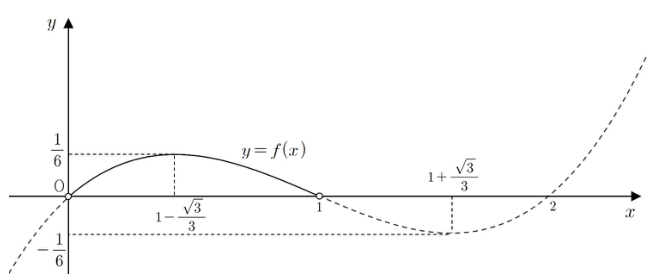
그러므로 S×BD2=34x(1x)(2x)\displaystyle S\times\overline{\mathrm{BD}}^2=\frac{\sqrt3}4x(1-x)(2-x)이다.f(x)=34x(1x)(2x)\displaystyle f(x)=\frac{\sqrt3}4x(1-x)(2-x)라 하면, f(x)=34(3x26x+2)\displaystyle f^{\prime}(x)=\frac{\sqrt3}4(3x^2-6x+2)이고, f(x)=0\displaystyle f^{\prime}(x)=0에서 x=3±33\displaystyle x=\frac{3\pm\sqrt3}3이다.이때 점 D는 선분 AC 위의 양 끝점점이 아닌 임의의 점이므로 0<x<1\displaystyle 0<x<1이다.Correction. ‘끝점점’은 ‘끝점’의 오기다. 그러나 원칙에 따라 원문 표기를 그대로 실었다.따라서 열린구간 (0,1)\displaystyle (0,1)에서 함수 f(x)\displaystyle f(x)의 증가와 감소를 표로 나타내고 y=f(x)\displaystyle y=f(x)의 그래프를 그리면 다음과 같다.x01331f(x)+0f(x)0160\displaystyle \begin{array}{c|ccccc}x&0&\cdots&1-\frac{\sqrt3}3&\cdots&1\\\hline f^{\prime}(x)&&+&0&-&\\\hline f(x)&0&\nearrow&\frac16&\searrow&0\end{array}

함수 f의 증가와 감소 및 극댓값

즉 함수 f(x)\displaystyle f(x)x=133\displaystyle x=1-\frac{\sqrt3}3에서 극대이면서 최대이다.따라서 최댓값을 갖게 하는 선분 AD의 길이는 133\displaystyle 1-\frac{\sqrt3}3이다.

첨삭 사례

아직 등록된 첨삭 사례가 없습니다.

질문과 답변 · 0개질문과 답변 · 고정 0개

아직 등록된 질문이 없습니다. 질문 작성은 멤버십 회원만 가능합니다.