수리논술, 배움에서 논증의 완성까지.

의·약학계 기하

문제

🔒
짧은 시간에 너무 많은 문제를 여셔서 열람을 잠시 제한했습니다. 잠시 후 다시 시도하시거나 로그인해 주세요.
해설강의 준비중
+4점 · 전개도로 최단 경로를 찾고, 이를 이용하여 선분의 길이를 계산할 수 있다.

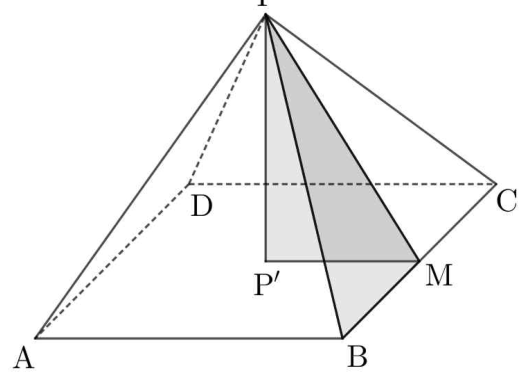
[기하-1]점 P에서 평면 ABCD에 내린 수선의 발을 P′이라 하고, 선분 BC의 중점을 M이라 하자.삼각형 PBM이 직각삼각형이므로PM2=PB2BM2=164=12\displaystyle \overline{\mathrm{PM}}^2=\overline{\mathrm{PB}}^2-\overline{\mathrm{BM}}^2=16-4=12이고 PM=23\displaystyle \overline{\mathrm{PM}}=2\sqrt3이다. 삼각형 PP′M이 직각삼각형이므로,PP2=PM2PM2=124=8\displaystyle \overline{\mathrm{PP}^{\prime}}^2=\overline{\mathrm{PM}}^2-\overline{\mathrm P^{\prime}\mathrm M}^2=12-4=8이고 PP=22\displaystyle \overline{\mathrm{PP}^{\prime}}=2\sqrt2이다.

사각뿔의 높이를 구하는 직각삼각형 PP′M

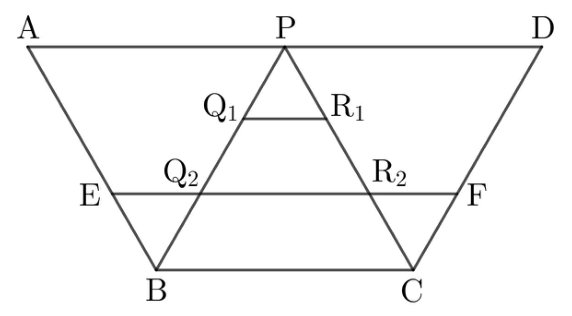
점 E에서 출발하여 사각뿔의 옆면을 따라 점 F에 도착하는 최단 경로는 다음 전개도에서 점 E와 점 F를 연결하는 직선 경로이다. 삼각형 EBQ2\displaystyle \mathrm{EBQ}_2는 정삼각형이므로, EB=Q2B\displaystyle \overline{\mathrm{EB}}=\overline{\mathrm Q_2\mathrm B}이다. 주어진 조건에서AB:EB=(k+1):1,PB:BQ1=(k+1):2\displaystyle \overline{\mathrm{AB}}:\overline{\mathrm{EB}}=(k+1):1,\quad\overline{\mathrm{PB}}:\overline{\mathrm{BQ}_1}=(k+1):2이므로PB:BQ2=AB:BE=(k+1):1.\displaystyle \overline{\mathrm{PB}}:\overline{\mathrm{BQ}_2}=\overline{\mathrm{AB}}:\overline{\mathrm{BE}}=(k+1):1.이와 같은 방법으로PC:CR2=DC:CF=(k+1):1\displaystyle \overline{\mathrm{PC}}:\overline{\mathrm{CR}_2}=\overline{\mathrm{DC}}:\overline{\mathrm{CF}}=(k+1):1임을 알 수 있다.

세 옆면의 전개도와 두 평행한 단면
+7점 · 두 평면 EQ1R1F\displaystyle \mathrm{EQ}_1\mathrm R_1\mathrm F와 ABCD의 관계, 두 평면 EQ2R2F\displaystyle \mathrm{EQ}_2\mathrm R_2\mathrm F와 ADP와의 관계를 알아내고 보일 수 있다.

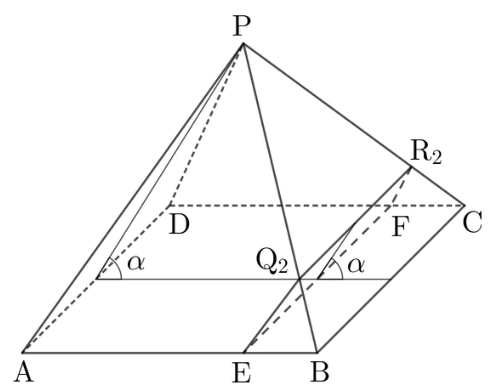
다음 그림에서 직선 EQ2\displaystyle \mathrm{EQ}_2와 직선 AP가 평행하므로 직선 EQ2\displaystyle \mathrm{EQ}_2는 직선 AP를 포함하는 평면 ADP와 평행하다. 이와 같은 방법으로, 직선 EF는 평면 ADP와 평행함을 알 수 있다. 평면 ADP 위에 있지 않은 한 점 E를 지나고 평면 ADP에 평행한 서로 다른 두 직선 EQ2\displaystyle \mathrm{EQ}_2와 EF에 의하여 결정되는 평면 EQ2R2F\displaystyle \mathrm{EQ}_2\mathrm R_2\mathrm F는 평면 ADP와 평행하다. 따라서 두 평면 ABCD와 EQ2R2F\displaystyle \mathrm{EQ}_2\mathrm R_2\mathrm F가 이루는 이면각의 크기를 α\displaystyle \alpha라 하면, 두 평면 ADP와 ABCD가 이루는 이면각의 크기도 α\displaystyle \alpha가 되어,sinα=2223=63\displaystyle \sin\alpha=\frac{2\sqrt2}{2\sqrt3}=\frac{\sqrt6}3이다.

평면 ADP와 평행한 단면 및 이면각 α

선분 AB의 중점과 선분 DC의 중점을 각각 점 N1,N2\displaystyle \mathrm N_1,\mathrm N_2라 할 때,PQ1:Q1B=N1E:EB=PR1:R1C=N2F:FC=(k1):2\displaystyle \overline{\mathrm{PQ}_1}:\overline{\mathrm Q_1\mathrm B}=\overline{\mathrm N_1\mathrm E}:\overline{\mathrm{EB}}=\overline{\mathrm{PR}_1}:\overline{\mathrm R_1\mathrm C}=\overline{\mathrm N_2\mathrm F}:\overline{\mathrm{FC}}=(k-1):2이다. 두 평면 EQ2R2F\displaystyle \mathrm{EQ}_2\mathrm R_2\mathrm F, ADP가 평행함을 보이는 방법으로, 두 평면 PN1N2\displaystyle \mathrm{PN}_1\mathrm N_2EQ1R1F\displaystyle \mathrm{EQ}_1\mathrm R_1\mathrm F는 평행함을 보일 수 있다. 따라서 평면 EQ1R1F\displaystyle \mathrm{EQ}_1\mathrm R_1\mathrm F는 평면 ABCD에 수직이다.

+4점 · 두 평면 EQ1R1F\displaystyle \mathrm{EQ}_1\mathrm R_1\mathrm F, EQ2R2F\displaystyle \mathrm{EQ}_2\mathrm R_2\mathrm F이 이루는 이면각의 크기의 코사인 값을 계산할 수 있다.

그러므로α+θ=π2\displaystyle \alpha+\theta=\frac\pi2이고cosθ=sinα=63\displaystyle \cos\theta=\sin\alpha=\frac{\sqrt6}3이다.

+6점 · 내접원의 (반)지름의 길이와 평행한 두 직선 Q1R1\displaystyle \mathrm Q_1\mathrm R_1Q2R2\displaystyle \mathrm Q_2\mathrm R_2사이의 거리를 계산할 수 있다.

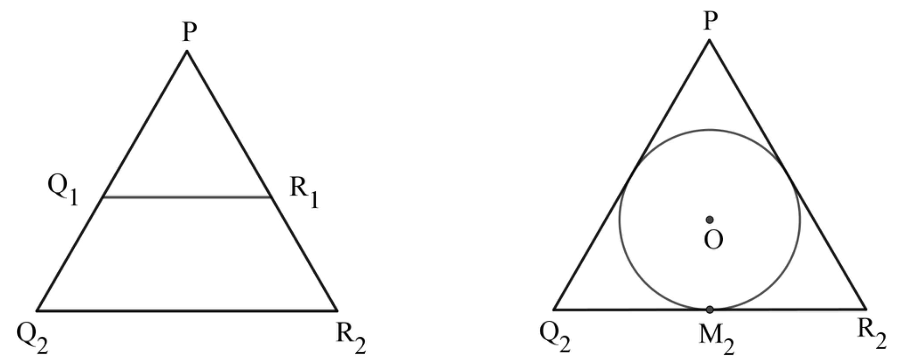
[기하-2]삼각형 PQ2R2\displaystyle \mathrm{PQ}_2\mathrm R_2의 내접원의 중심을 점 O라 하자. 삼각형 PQ2R2\displaystyle \mathrm{PQ}_2\mathrm R_2는 정삼각형이므로 점 O는 삼각형 PQ2R2\displaystyle \mathrm{PQ}_2\mathrm R_2의 무게중심이 되어, 내접원의 반지름의 길이 r\displaystyle rr=13PM2=13×33×12×Q2R2=123×kk+1×BC=23k3(k+1)\displaystyle r=\frac13\overline{\mathrm{PM}_2}=\frac13\times\frac3{\sqrt3}\times\frac12\times\overline{\mathrm Q_2\mathrm R_2}=\frac1{2\sqrt3}\times\frac{k}{k+1}\times\overline{\mathrm{BC}}=\frac{2\sqrt3k}{3(k+1)}이다. 선분 Q1R1\displaystyle \mathrm Q_1\mathrm R_1이 삼각형 PQ2R2\displaystyle \mathrm{PQ}_2\mathrm R_2의 내접원에 접하거나 만나지 않으면, 이 내접원은 사각형 Q1Q2R2R1\displaystyle \mathrm Q_1\mathrm Q_2\mathrm R_2\mathrm R_1에 포함되는 원 중에 최대 지름을 갖는 원이 된다.

삼각형 PQ₂R₂의 내접원과 사각형 Q₁Q₂R₂R₁

선분 Q1R1\displaystyle \mathrm Q_1\mathrm R_1이 삼각형 PQ2R2\displaystyle \mathrm{PQ}_2\mathrm R_2의 내접원에 접하는 경우를 조사하기 위해, 점 M1\displaystyle \mathrm M_1M2\displaystyle \mathrm M_2를 각각 선분 Q1R1\displaystyle \mathrm Q_1\mathrm R_1과 선분 Q2R2\displaystyle \mathrm Q_2\mathrm R_2의 중점이라 하자. 선분 M1M2\displaystyle \mathrm M_1\mathrm M_2의 길이는M1M2=1k+1×PM=1k+1×32×BC=23k+1\displaystyle \overline{\mathrm M_1\mathrm M_2}=\frac1{k+1}\times\overline{\mathrm{PM}}=\frac1{k+1}\times\frac{\sqrt3}2\times\overline{\mathrm{BC}}=\frac{2\sqrt3}{k+1}

+3점 · k=1.5\displaystyle k=1.5를 기준으로 경우를 나눌 수 있다.

이다. 선분 M1M2\displaystyle \mathrm M_1\mathrm M_2의 길이와 내접원의 지름이 같아지는 경우가 선분 Q1R1\displaystyle \mathrm Q_1\mathrm R_1이 내접원에 접할 때이다. 즉,43k3(k+1)=23k+1\displaystyle \frac{4\sqrt3k}{3(k+1)}=\frac{2\sqrt3}{k+1}이고, 이때 k=1.5\displaystyle k=1.5이다.

+6점 · 정사영의 넓이를 계산할 수 있다.

ⅰ) k1.5\displaystyle k\le1.5인 경우.위와 같이 삼각형 PQ2R2\displaystyle \mathrm{PQ}_2\mathrm R_2의 내접원이 사각형 Q1Q2R2R1\displaystyle \mathrm Q_1\mathrm Q_2\mathrm R_2\mathrm R_1에 포함된다. 이때 원의 반지름은 r=23k3(k+1)\displaystyle r=\frac{2\sqrt3k}{3(k+1)}이다. 원의 넓이는 4k2π3(k+1)2\displaystyle \frac{4k^2\pi}{3(k+1)^2}이고 cos(PMP)=33\displaystyle \cos(\angle\mathrm{PMP}^{\prime})=\frac{\sqrt3}3이므로, 이 원의 평면 ABCD로의 정사영의 넓이는(원의 넓이)×cos(PMP)=4k2π3(k+1)2×33=43k2π9(k+1)2\displaystyle (\text{원의 넓이})\times\cos(\angle\mathrm{PMP}^{\prime})=\frac{4k^2\pi}{3(k+1)^2}\times\frac{\sqrt3}3=\frac{4\sqrt3k^2\pi}{9(k+1)^2}이다.ⅱ) k>1.5\displaystyle k>1.5인 경우.이 경우, 사각형 Q1Q2R2R1\displaystyle \mathrm Q_1\mathrm Q_2\mathrm R_2\mathrm R_1에 포함되는 최대 지름을 갖는 원의 지름은 M1M2\displaystyle \overline{\mathrm M_1\mathrm M_2}이다. 즉, 최대 지름은 23k+1\displaystyle \frac{2\sqrt3}{k+1}이고, 원의 넓이는 3π(k+1)2\displaystyle \frac{3\pi}{(k+1)^2}이다. cos(PMP)=33\displaystyle \cos(\angle\mathrm{PMP}^{\prime})=\frac{\sqrt3}3이므로, 이 원의 평면 ABCD로의 정사영의 넓이는(원의 넓이)×cos(PMP)=3π(k+1)2×33=3π(k+1)2\displaystyle (\text{원의 넓이})\times\cos(\angle\mathrm{PMP}^{\prime})=\frac{3\pi}{(k+1)^2}\times\frac{\sqrt3}3=\frac{\sqrt3\pi}{(k+1)^2}이다.

첨삭 사례

아직 등록된 첨삭 사례가 없습니다.

질문과 답변 · 0개질문과 답변 · 고정 0개

아직 등록된 질문이 없습니다. 질문 작성은 멤버십 회원만 가능합니다.