+2점 · h ( x ) = x − ln ( 1 + x ) \displaystyle h(x)=\sqrt{x}-\ln(1+x) h ( x ) = x − ln ( 1 + x ) ln ( 1 + x ) ≤ x \displaystyle \ln(1+x)\le\sqrt{x} ln ( 1 + x ) ≤ x [미적분-1] x ≥ 0 \displaystyle x\ge0 x ≥ 0 h ( x ) = x − ln ( 1 + x ) \displaystyle h(x)=\sqrt{x}-\ln(1+x) h ( x ) = x − ln ( 1 + x ) x > 0 \displaystyle x>0 x > 0 h ′ ( x ) = 1 2 x − 1 1 + x = ( x − 1 ) 2 2 x ( 1 + x ) ≥ 0 \displaystyle h^{\prime}(x)=\frac1{2\sqrt{x}}-\frac1{1+x}=\frac{(\sqrt{x}-1)^2}{2\sqrt{x}(1+x)}\ge0 h ′ ( x ) = 2 x 1 − 1 + x 1 = 2 x ( 1 + x ) ( x − 1 ) 2 ≥ 0 h ( 0 ) = 0 \displaystyle h(0)=0 h ( 0 ) = 0 x ≥ 0 \displaystyle x\ge0 x ≥ 0 h ( x ) ≥ 0 \displaystyle h(x)\ge0 h ( x ) ≥ 0 ln ( 1 + x ) ≤ x \displaystyle \ln(1+x)\le\sqrt{x} ln ( 1 + x ) ≤ x
+3점 · 0 ≤ x ln ( 1 + 1 x ) ≤ x 1 x \displaystyle 0\le x\ln\left(1+\frac1x\right)\le x\frac1{\sqrt{x}} 0 ≤ x ln ( 1 + x 1 ) ≤ x x 1 lim x → 0 + x ln ( 1 + 1 x ) = 0 \displaystyle \lim_{x\to0+}x\ln\left(1+\frac1x\right)=0 x → 0 + lim x ln ( 1 + x 1 ) = 0 또, x > 0 \displaystyle x>0 x > 0 0 ≤ ln ( 1 + 1 x ) ≤ 1 x \displaystyle 0\le\ln\left(1+\frac1x\right)\le\frac1{\sqrt{x}} 0 ≤ ln ( 1 + x 1 ) ≤ x 1 0 ≤ x ln ( 1 + 1 x ) ≤ x 1 x \displaystyle 0\le x\ln\left(1+\frac1x\right)\le x\frac1{\sqrt{x}} 0 ≤ x ln ( 1 + x 1 ) ≤ x x 1 이때 lim x → 0 + x 1 x = 0 \displaystyle \lim_{x\to0+}x\frac1{\sqrt{x}}=0 x → 0 + lim x x 1 = 0 lim x → 0 + x ln ( 1 + 1 x ) = 0 \displaystyle \lim_{x\to0+}x\ln\left(1+\frac1x\right)=0 x → 0 + lim x ln ( 1 + x 1 ) = 0
+3점 · f ( x ) = ( 1 + 1 x ) x + α \displaystyle f(x)=\left(1+\frac1x\right)^{x+\alpha} f ( x ) = ( 1 + x 1 ) x + α f ′ ( x ) = f ( x ) g ( x ) \displaystyle f^{\prime}(x)=f(x)g(x) f ′ ( x ) = f ( x ) g ( x ) g ( x ) \displaystyle g(x) g ( x ) [미적분-2] f ( x ) = ( 1 + 1 x ) x + α \displaystyle f(x)=\left(1+\frac1x\right)^{x+\alpha} f ( x ) = ( 1 + x 1 ) x + α ln f ( x ) = ( x + α ) ln ( 1 + 1 x ) \displaystyle \ln f(x)=(x+\alpha)\ln\left(1+\frac1x\right) ln f ( x ) = ( x + α ) ln ( 1 + x 1 ) 위 식의 양변을 x \displaystyle x x f ′ ( x ) f ( x ) = ln ( 1 + 1 x ) − x + α x 2 + x \displaystyle \frac{f^{\prime}(x)}{f(x)}=\ln\left(1+\frac1x\right)-\frac{x+\alpha}{x^2+x} f ( x ) f ′ ( x ) = ln ( 1 + x 1 ) − x 2 + x x + α g ( x ) = ln ( 1 + 1 x ) − x + α x 2 + x \displaystyle g(x)=\ln\left(1+\frac1x\right)-\frac{x+\alpha}{x^2+x} g ( x ) = ln ( 1 + x 1 ) − x 2 + x x + α f ′ ( x ) = f ( x ) g ( x ) \displaystyle f^{\prime}(x)=f(x)g(x) f ′ ( x ) = f ( x ) g ( x ) x > 0 \displaystyle x>0 x > 0 f ( x ) > 0 \displaystyle f(x)>0 f ( x ) > 0 g ( x ) \displaystyle g(x) g ( x )
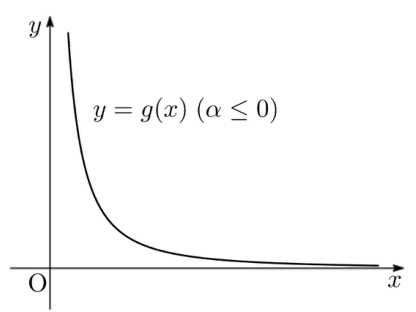
+5점 · g ′ ( x ) = ( 2 α − 1 ) x + α ( x 2 + x ) 2 \displaystyle g^{\prime}(x)=\frac{(2\alpha-1)x+\alpha}{(x^2+x)^2} g ′ ( x ) = ( x 2 + x ) 2 ( 2 α − 1 ) x + α α ≤ 0 \displaystyle \alpha\le0 α ≤ 0 x > 0 \displaystyle x>0 x > 0 g ′ ( x ) < 0 \displaystyle g^{\prime}(x)<0 g ′ ( x ) < 0 lim x → ∞ g ( x ) = 0 \displaystyle \lim_{x\to\infty}g(x)=0 x → ∞ lim g ( x ) = 0 f ( x ) \displaystyle f(x) f ( x ) 이때 lim x → ∞ g ( x ) = 0 \displaystyle \lim_{x\to\infty}g(x)=0 x → ∞ lim g ( x ) = 0 g ′ ( x ) = ( 2 α − 1 ) x + α ( x 2 + x ) 2 \displaystyle g^{\prime}(x)=\frac{(2\alpha-1)x+\alpha}{(x^2+x)^2} g ′ ( x ) = ( x 2 + x ) 2 ( 2 α − 1 ) x + α (ⅰ) α ≤ 0 \displaystyle \alpha\le0 α ≤ 0 x > 0 \displaystyle x>0 x > 0 g ′ ( x ) < 0 \displaystyle g^{\prime}(x)<0 g ′ ( x ) < 0 x > 0 \displaystyle x>0 x > 0 g ( x ) \displaystyle g(x) g ( x ) 이때 lim x → ∞ g ( x ) = 0 \displaystyle \lim_{x\to\infty}g(x)=0 x → ∞ lim g ( x ) = 0 x > 0 \displaystyle x>0 x > 0 g ( x ) > 0 \displaystyle g(x)>0 g ( x ) > 0 f ′ ( x ) > 0 \displaystyle f^{\prime}(x)>0 f ′ ( x ) > 0 따라서 함수 f ( x ) \displaystyle f(x) f ( x ) ( 0 , ∞ ) \displaystyle (0,\infty) ( 0 , ∞ )
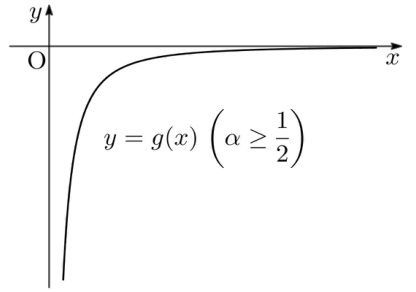
+2점 · α ≥ 1 2 \displaystyle \alpha\ge\frac12 α ≥ 2 1 x > 0 \displaystyle x>0 x > 0 g ′ ( x ) > 0 \displaystyle g^{\prime}(x)>0 g ′ ( x ) > 0 lim x → ∞ g ( x ) = 0 \displaystyle \lim_{x\to\infty}g(x)=0 x → ∞ lim g ( x ) = 0 f ( x ) \displaystyle f(x) f ( x ) (ⅱ) α ≥ 1 2 \displaystyle \alpha\ge\frac12 α ≥ 2 1 x > 0 \displaystyle x>0 x > 0 g ′ ( x ) > 0 \displaystyle g^{\prime}(x)>0 g ′ ( x ) > 0 x > 0 \displaystyle x>0 x > 0 g ( x ) \displaystyle g(x) g ( x ) 이때 lim x → ∞ g ( x ) = 0 \displaystyle \lim_{x\to\infty}g(x)=0 x → ∞ lim g ( x ) = 0 x > 0 \displaystyle x>0 x > 0 g ( x ) < 0 \displaystyle g(x)<0 g ( x ) < 0 f ′ ( x ) < 0 \displaystyle f^{\prime}(x)<0 f ′ ( x ) < 0 따라서 함수 f ( x ) \displaystyle f(x) f ( x ) ( 0 , ∞ ) \displaystyle (0,\infty) ( 0 , ∞ )
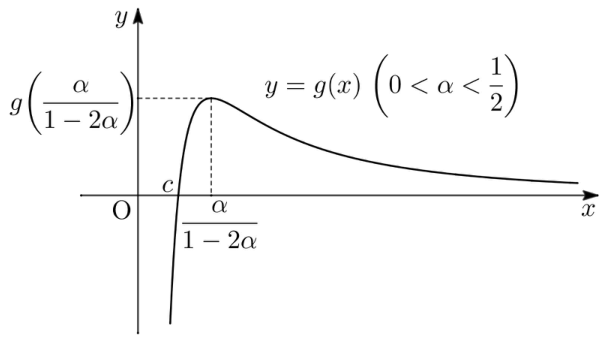
+3점 · k = α 1 − 2 α > 0 \displaystyle k=\frac\alpha{1-2\alpha}>0 k = 1 − 2 α α > 0 g ′ ( k ) = 0 \displaystyle g^{\prime}(k)=0 g ′ ( k ) = 0 x < k \displaystyle x<k x < k g ′ ( x ) > 0 \displaystyle g^{\prime}(x)>0 g ′ ( x ) > 0 x > k \displaystyle x>k x > k g ′ ( x ) < 0 \displaystyle g^{\prime}(x)<0 g ′ ( x ) < 0 ( k , ∞ ) \displaystyle (k,\infty) ( k , ∞ ) g ( x ) > 0 \displaystyle g(x)>0 g ( x ) > 0 [미적분-3] g ′ ( x ) = ( 2 α − 1 ) x + α ( x 2 + x ) 2 = 0 \displaystyle g^{\prime}(x)=\frac{(2\alpha-1)x+\alpha}{(x^2+x)^2}=0 g ′ ( x ) = ( x 2 + x ) 2 ( 2 α − 1 ) x + α = 0 g ′ ( α 1 − 2 α ) = 0 \displaystyle g^{\prime}\left(\frac\alpha{1-2\alpha}\right)=0 g ′ ( 1 − 2 α α ) = 0 k = α 1 − 2 α > 0 \displaystyle k=\frac\alpha{1-2\alpha}>0 k = 1 − 2 α α > 0 x < k \displaystyle x<k x < k g ′ ( x ) > 0 \displaystyle g^{\prime}(x)>0 g ′ ( x ) > 0 x > k \displaystyle x>k x > k g ′ ( x ) < 0 \displaystyle g^{\prime}(x)<0 g ′ ( x ) < 0 이때 [미적분-2]에서 lim x → ∞ g ( x ) = 0 \displaystyle \lim_{x\to\infty}g(x)=0 x → ∞ lim g ( x ) = 0 g ( x ) \displaystyle g(x) g ( x ) ( k , ∞ ) \displaystyle (k,\infty) ( k , ∞ ) ( k , ∞ ) \displaystyle (k,\infty) ( k , ∞ ) g ( x ) > 0 \displaystyle g(x)>0 g ( x ) > 0 ⋯ i) \displaystyle \qquad\cdots\;\text{i)} ⋯ i) 함수 g ( x ) \displaystyle g(x) g ( x ) x = k \displaystyle x=k x = k g ( k ) > 0 ( g ( k ) = lim x → k + g ( x ) ≥ g ( 2 k ) > 0 ) \displaystyle g(k)>0\;\left(g(k)=\lim_{x\to k+}g(x)\ge g(2k)>0\right) g ( k ) > 0 ( g ( k ) = x → k + lim g ( x ) ≥ g ( 2 k ) > 0 ) ⋯ ii) \displaystyle \qquad\cdots\;\text{ii)} ⋯ ii)
+4점 · lim x → 0 + x ln ( 1 + 1 x ) = 0 \displaystyle \lim_{x\to0+}x\ln\left(1+\frac1x\right)=0 x → 0 + lim x ln ( 1 + x 1 ) = 0 lim x → 0 + g ( x ) = − ∞ \displaystyle \lim_{x\to0+}g(x)=-\infty x → 0 + lim g ( x ) = − ∞ 한편, [미적분-1]에서의 lim x → 0 + x ln ( 1 + 1 x ) = 0 \displaystyle \lim_{x\to0+}x\ln\left(1+\frac1x\right)=0 x → 0 + lim x ln ( 1 + x 1 ) = 0 lim x → 0 + x g ( x ) = lim x → 0 + { x ln ( 1 + 1 x ) − x + α x + 1 } = − α < 0 \displaystyle \lim_{x\to0+}xg(x)=\lim_{x\to0+}\left\{x\ln\left(1+\frac1x\right)-\frac{x+\alpha}{x+1}\right\}=-\alpha<0 x → 0 + lim xg ( x ) = x → 0 + lim { x ln ( 1 + x 1 ) − x + 1 x + α } = − α < 0 lim x → 0 + g ( x ) = − ∞ \displaystyle \lim_{x\to0+}g(x)=-\infty x → 0 + lim g ( x ) = − ∞
+5점 · 제시문 (나)에 의하여 g ( c ) = 0 \displaystyle g(c)=0 g ( c ) = 0 c \displaystyle c c ( 0 , k ) \displaystyle (0,k) ( 0 , k ) ( 0 , k ) \displaystyle (0,k) ( 0 , k ) g ′ ( x ) > 0 \displaystyle g^{\prime}(x)>0 g ′ ( x ) > 0 x < c \displaystyle x<c x < c g ( x ) < 0 \displaystyle g(x)<0 g ( x ) < 0 x > c \displaystyle x>c x > c g ( x ) > 0 \displaystyle g(x)>0 g ( x ) > 0 또, 연속함수 g ( x ) \displaystyle g(x) g ( x ) g ( k ) > 0 \displaystyle g(k)>0 g ( k ) > 0 제시문 (나)에 의하여 g ( c ) = 0 \displaystyle g(c)=0 g ( c ) = 0 c \displaystyle c c ( 0 , k ) \displaystyle (0,k) ( 0 , k )
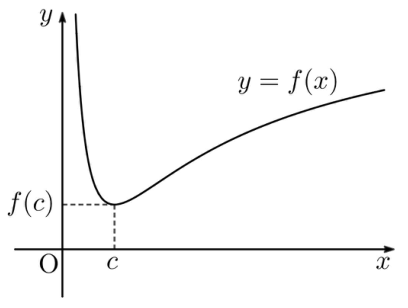
열린구간 ( 0 , k ) \displaystyle (0,k) ( 0 , k ) g ′ ( x ) > 0 \displaystyle g^{\prime}(x)>0 g ′ ( x ) > 0 ( 0 , k ) \displaystyle (0,k) ( 0 , k ) g ( x ) \displaystyle g(x) g ( x ) x < c \displaystyle x<c x < c g ( x ) < 0 \displaystyle g(x)<0 g ( x ) < 0 c < x < k \displaystyle c<x<k c < x < k g ( x ) > 0 \displaystyle g(x)>0 g ( x ) > 0 x > c \displaystyle x>c x > c g ( x ) > 0 \displaystyle g(x)>0 g ( x ) > 0 그러므로 f ′ ( x ) = f ( x ) g ( x ) \displaystyle f^{\prime}(x)=f(x)g(x) f ′ ( x ) = f ( x ) g ( x ) f ′ ( c ) = 0 \displaystyle f^{\prime}(c)=0 f ′ ( c ) = 0 x < c \displaystyle x<c x < c f ′ ( x ) < 0 \displaystyle f^{\prime}(x)<0 f ′ ( x ) < 0 x > c \displaystyle x>c x > c f ′ ( x ) > 0 \displaystyle f^{\prime}(x)>0 f ′ ( x ) > 0 x ⋯ c ⋯ f ′ ( x ) − 0 + f ( x ) ↘ f ( c ) ↗ \displaystyle \begin{array}{c|ccc}x&\cdots&c&\cdots\\\hline f^{\prime}(x)&-&0&+\\\hline f(x)&\searrow&f(c)&\nearrow\end{array} x f ′ ( x ) f ( x ) ⋯ − ↘ c 0 f ( c ) ⋯ + ↗
+3점 · f ( x ) \displaystyle f(x) f ( x ) ( 0 , c ) \displaystyle (0,c) ( 0 , c ) f ( x ) \displaystyle f(x) f ( x ) ( c , ∞ ) \displaystyle (c,\infty) ( c , ∞ ) f ( x ) \displaystyle f(x) f ( x ) x = c \displaystyle x=c x = c f ( x ) \displaystyle f(x) f ( x ) ( 0 , c ) \displaystyle (0,c) ( 0 , c ) f ( x ) \displaystyle f(x) f ( x ) ( c , ∞ ) \displaystyle (c,\infty) ( c , ∞ ) x = c \displaystyle x=c x = c f ( x ) \displaystyle f(x) f ( x ) x = c \displaystyle x=c x = c Correction. 여기서 부호가 바뀌는 것은 f ( x ) \displaystyle f(x) f ( x ) f ′ ( x ) \displaystyle f^{\prime}(x) f ′ ( x )
 수리논술, 배움에서 논증의 완성까지.