수리논술, 배움에서 논증의 완성까지.

자연계열 기하

문제

🔒
짧은 시간에 너무 많은 문제를 여셔서 열람을 잠시 제한했습니다. 잠시 후 다시 시도하시거나 로그인해 주세요.
해설강의 준비중
+3점 · 도형 V1\displaystyle V_1과 접하는 사다리꼴 ABFE에 대하여 RF=1\displaystyle \overline{\mathrm{RF}}=1임을 나타낼 수 있다.

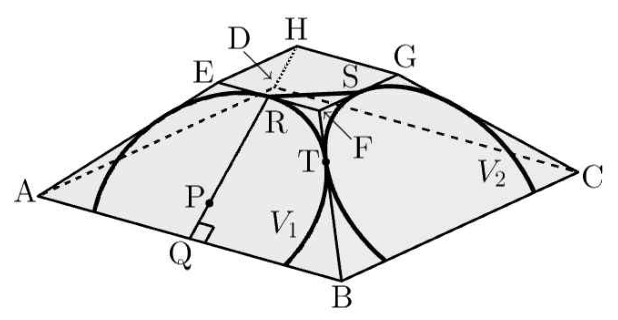
[기하-1] AE,  EF,  FB\displaystyle \overline{\mathrm{AE}},\;\overline{\mathrm{EF}},\;\overline{\mathrm{FB}}에 도형 V1\displaystyle V_1이 접하도록 사각뿔대 ABCD-EFGH를 만들면 다음과 같다.

사각뿔대 ABCD-EFGH와 도형 V₁, V₂

RS=2\displaystyle \overline{\mathrm{RS}}=\sqrt2일 때, RFS\displaystyle \triangle\mathrm{RFS}F=90\displaystyle \angle\mathrm F=90^\circ인 직각이등변삼각형이므로 RF=1\displaystyle \overline{\mathrm{RF}}=1이다.도형 V1\displaystyle V_1과 도형 V2\displaystyle V_2가 만나는 점을 T라 할 때, 점 F에서 도형 V1\displaystyle V_1에 그은 접선의 길이는 같으므로 RF=1\displaystyle \overline{\mathrm{RF}}=1이다.Comment. 접선의 길이가 같으므로 FT=FR=1\displaystyle \overline{\mathrm{FT}}=\overline{\mathrm{FR}}=1이다.

+2점 · 선분 PQ의 길이를 a\displaystyle a라 할 때, 선분 BP의 길이를 a2+9\displaystyle \sqrt{a^2+9}로 나타낼 수 있다.

이때 PQ=a\displaystyle \overline{\mathrm{PQ}}=a라 하자. 주어진 조건에 의해 BQ=3\displaystyle \overline{\mathrm{BQ}}=3이고, PQB\displaystyle \triangle\mathrm{PQB}는 직각삼각형이므로 BP=a2+9\displaystyle \overline{\mathrm{BP}}=\sqrt{a^2+9}이다.

+3점 · 선분 TB의 길이를 a2+5\displaystyle \sqrt{a^2+5}로 나타낼 수 있다.

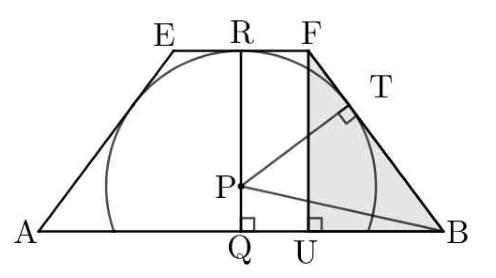
또한 PT\displaystyle \overline{\mathrm{PT}}PR\displaystyle \overline{\mathrm{PR}}은 원의 반지름이므로 PT=PR=2\displaystyle \overline{\mathrm{PT}}=\overline{\mathrm{PR}}=2이며, PTB\displaystyle \triangle\mathrm{PTB}는 직각삼각형이므로 TB=a2+5\displaystyle \overline{\mathrm{TB}}=\sqrt{a^2+5}이다.

사다리꼴 ABFE에 접하는 원
+7점 · 직각삼각형 FUB의 각 변의 길이 사이의 관계를 (a+2)2+22=(1+a2+5)2\displaystyle (a+2)^2+2^2=(1+\sqrt{a^2+5})^2으로 나타내고, 선분 PQ의 길이가 23\displaystyle \frac23임을 구할 수 있다.

점 F에서 선분 AB에 내린 수선의 발을 U라 하자. FU=RQ=a+2\displaystyle \overline{\mathrm{FU}}=\overline{\mathrm{RQ}}=a+2이고,UB=QBQU=QBRF=31=2\displaystyle \overline{\mathrm{UB}}=\overline{\mathrm{QB}}-\overline{\mathrm{QU}}=\overline{\mathrm{QB}}-\overline{\mathrm{RF}}=3-1=2이며,FB=FT+TB=1+a2+5\displaystyle \overline{\mathrm{FB}}=\overline{\mathrm{FT}}+\overline{\mathrm{TB}}=1+\sqrt{a^2+5}이다. FUB\displaystyle \triangle\mathrm{FUB}는 직각삼각형이므로 (a+2)2+22=(1+a2+5)2\displaystyle (a+2)^2+2^2=(1+\sqrt{a^2+5})^2이다.따라서 a2+4a+8=1+2a2+5+a2+5,  4a+2=2a2+5,  (2a+1)2=a2+5,  4a2+4a+1=a2+5\displaystyle a^2+4a+8=1+2\sqrt{a^2+5}+a^2+5,\;4a+2=2\sqrt{a^2+5},\;(2a+1)^2=a^2+5,\;4a^2+4a+1=a^2+5,3a2+4a4=0,  (3a2)(a+2)=0,  a=23\displaystyle 3a^2+4a-4=0,\;(3a-2)(a+2)=0,\;a=\frac23 또는 a=2\displaystyle a=-2이고, a>0\displaystyle a>0이므로 a=23\displaystyle a=\frac23이다.즉, 선분 PQ의 길이는 23\displaystyle \frac23이다.

+3점 · PMN\displaystyle \triangle\mathrm{PMN}의 넓이가 829\displaystyle \frac{8\sqrt2}9임을 구할 수 있다.

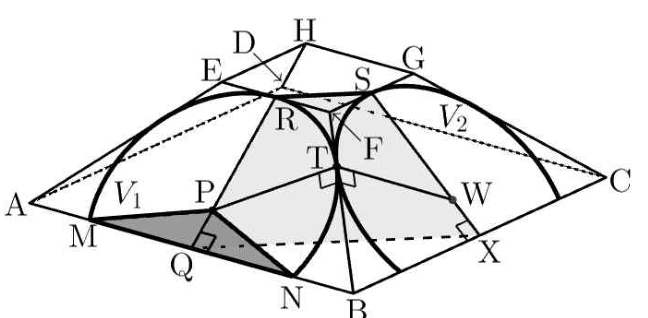
[기하-2] 도형 V1\displaystyle V_1 위에 있는 PMN\displaystyle \triangle\mathrm{PMN}에 대하여 PQ=23\displaystyle \overline{\mathrm{PQ}}=\frac23이므로 QN=22(23)2=329=423\displaystyle \overline{\mathrm{QN}}=\sqrt{2^2-\left(\frac23\right)^2}=\sqrt{\frac{32}9}=\frac{4\sqrt2}3이다.따라서 PMN\displaystyle \triangle\mathrm{PMN}의 넓이는 423×23=829\displaystyle \frac{4\sqrt2}3\times\frac23=\frac{8\sqrt2}9이다.

평면 ABF와 평면 BCF의 이면각
+3점 · 평면 ABF와 평면 BCF의 이면각의 크기를 정의할 수 있다.

도형 V2\displaystyle V_2가 포함된 평면으로의 PMN\displaystyle \triangle\mathrm{PMN}의 정사영을 구하기 위해서는 평면 ABF와 평면 BCF가 이루는 각의 크기를 구하면 된다. 즉, 평면 BCF 위에 있는 원의 중심을 W라 하면, 이면각의 정의에 의해 직선 PT와 직선 WT가 이루는 각을 구하면 된다.

+3점 · 평면 BCF 위에 있는 원의 중심을 W라 할 때, 선분 PW의 길이가 522\displaystyle \frac52\sqrt2임을 구할 수 있다.

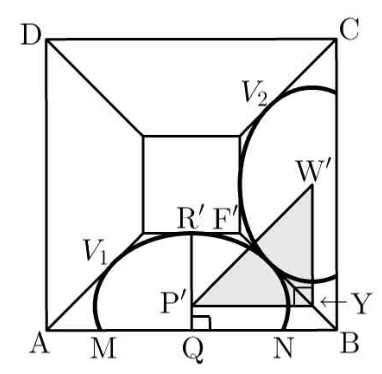
점 W에서 선분 BC에 내린 수선의 발을 X라 하자. 점 P, R, S, W, F의 평면 ABC 위로의 정사영을 각각 P′, R′, S′, W′, F′이라 하면 다음 그림과 같다.

각 점의 평면 ABC 위로의 정사영

점 P는 선분 RQ를 3:1\displaystyle 3:1로 내분하는 점이므로 점 P′은 선분 R′Q를 3:1\displaystyle 3:1로 내분하는 점이다. 이때 RQ=2\displaystyle \overline{\mathrm R^{\prime}\mathrm Q}=2이므로 PQ=12\displaystyle \overline{\mathrm P^{\prime}\mathrm Q}=\frac12이다. 이때 점 P′을 지나고 선분 AB에 평행인 직선이 선분 F′B와 만나는 점을 Y라 하면,PY=QBPQ=312=52\displaystyle \overline{\mathrm P^{\prime}\mathrm Y}=\overline{\mathrm{QB}}-\overline{\mathrm P^{\prime}\mathrm Q}=3-\frac12=\frac52이다.PW=PW\displaystyle \overline{\mathrm{PW}}=\overline{\mathrm P^{\prime}\mathrm W^{\prime}}이고, PYW\displaystyle \triangle\mathrm P^{\prime}\mathrm Y\mathrm W^{\prime}은 직각이등변삼각형이므로 PW=522\displaystyle \overline{\mathrm P^{\prime}\mathrm W^{\prime}}=\frac52\sqrt2이므로

+3점 · PTW=θ\displaystyle \angle\mathrm{PTW}=\theta라 할 때, cosθ=916\displaystyle \cos\theta=-\frac9{16}임을 구할 수 있다.

PTW=θ\displaystyle \angle\mathrm{PTW}=\theta라 하면, 코사인법칙에 의해cosθ=PT2+TW2PW22×PT×TW=4+42522×2×2=928=916\displaystyle \cos\theta=\frac{\overline{\mathrm{PT}}^2+\overline{\mathrm{TW}}^2-\overline{\mathrm{PW}}^2}{2\times\overline{\mathrm{PT}}\times\overline{\mathrm{TW}}}=\frac{4+4-\dfrac{25}2}{2\times2\times2}=\frac{-\dfrac92}8=-\frac9{16}이다.

+3점 · 도형 V2\displaystyle V_2가 포함된 평면으로의 PMN\displaystyle \triangle\mathrm{PMN}의 정사영의 넓이가 22\displaystyle \frac{\sqrt2}2임을 구할 수 있다.

즉, cosθ<0\displaystyle \cos\theta<0이므로 θ>π2\displaystyle \theta>\frac\pi2이고, 따라서 평면 ABF와 평면 BCG가 이루는 각의 크기는 πθ\displaystyle \pi-\theta이다.그러므로 도형 V2\displaystyle V_2가 포함된 평면으로의 PMN\displaystyle \triangle\mathrm{PMN}의 정사영의 넓이는829×cos(πθ)=829×(cosθ)=22\displaystyle \frac{8\sqrt2}9\times\cos(\pi-\theta)=\frac{8\sqrt2}9\times(-\cos\theta)=\frac{\sqrt2}2이다.

첨삭 사례

아직 등록된 첨삭 사례가 없습니다.

질문과 답변 · 0개질문과 답변 · 고정 0개

아직 등록된 질문이 없습니다. 질문 작성은 멤버십 회원만 가능합니다.