수리논술, 이게 다다.

자연계열 A 3번

오류 제보

전체 시험 시간 120분

문제

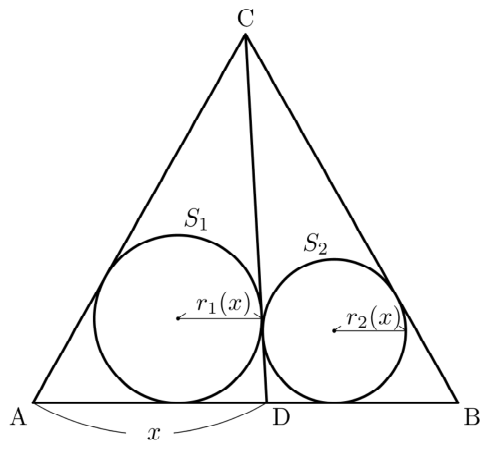
[문제 3] 그림과 같이 한 변의 길이가 2\displaystyle 2인 정삼각형 ABC\displaystyle \mathrm{ABC}의 밑변 AB\displaystyle \mathrm{AB} 위의 한 점 D\displaystyle \mathrm{D}에 대하여, 삼각형 ACD\displaystyle \mathrm{ACD}에 내접하는 원을 S1\displaystyle S_1, 삼각형 BCD\displaystyle \mathrm{BCD}에 내접하는 원을 S2\displaystyle S_2라 하자. 선분 AD\displaystyle \mathrm{AD}의 길이가 x\displaystyle x일 때, S1\displaystyle S_1, S2\displaystyle S_2의 반지름의 길이를 각각 r1(x)\displaystyle r_1(x), r2(x)\displaystyle r_2(x)라 정의하자. 닫힌구간 [0,2]\displaystyle [0,2]에서 정의된 연속함수 f(x)\displaystyle f(x)는 0<x<2\displaystyle 0<x<2일 때, f(x)=r1(x)+r2(x)\displaystyle f(x)=r_1(x)+r_2(x)이다.

정삼각형을 나눈 두 삼각형에 내접하는 원

(3-1) 함수 f(x)\displaystyle f(x)를 구하시오. 또한 f\displaystyle f의 치역을 구하시오. (80점)

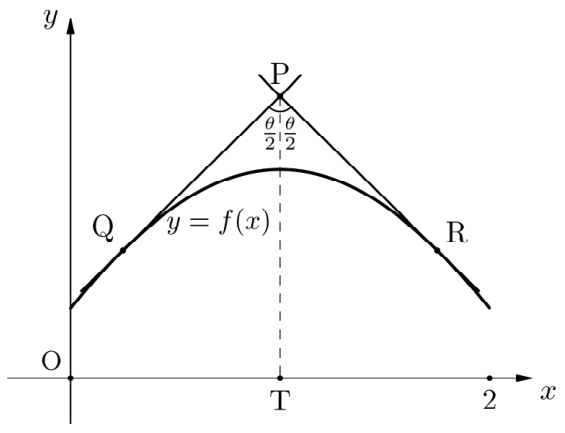
(3-2) x\displaystyle x좌표가 1\displaystyle 1인 점 P\displaystyle \mathrm{P}를 지나는 두 직선이 곡선 y=f(x)\displaystyle y=f(x)에 점 Q\displaystyle \mathrm{Q}와 점 R\displaystyle \mathrm{R}에서 각각 접한다. Q\displaystyle \mathrm{Q}의 x\displaystyle x좌표가 14\displaystyle \frac14이고 ∠QPR=θ\displaystyle \angle\mathrm{QPR}=\theta일 때, sin⁡θ\displaystyle \sin\theta의 값을 구하시오. (80점)

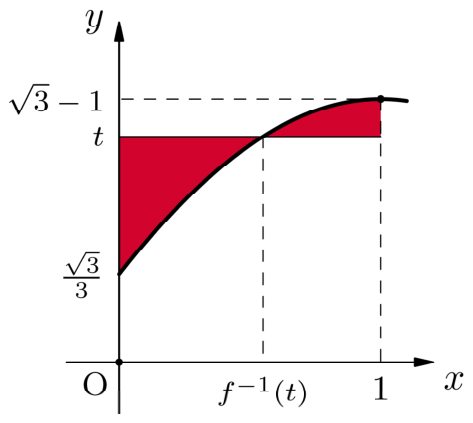
(3-3) f\displaystyle f의 치역에 속하는 t\displaystyle t에 대하여 g(t)=∫02∣f(x)−t∣dx\displaystyle g(t)=\int_0^2|f(x)-t|dx라 하자. 함수 g(t)\displaystyle g(t)가 t=α\displaystyle t=\alpha에서 최솟값을 가질 때, α\displaystyle \alpha의 값을 구하시오. (80점)

해설강의 준비중
+30점 · r1(x)=3(x+2−x2−2x+4)6\displaystyle r_1(x)=\frac{\sqrt3(x+2-\sqrt{x^2-2x+4})}6

(3-1) ∠CAD=π3\displaystyle \angle\mathrm{CAD}=\frac\pi3이므로 코사인 법칙에 의하여 CD‾2=x2+4−2x\displaystyle \overline{\mathrm{CD}}^2=x^2+4-2x이다. 따라서 CD‾=x2−2x+4\displaystyle \overline{\mathrm{CD}}=\sqrt{x^2-2x+4}이다. 삼각형 ADC\displaystyle \mathrm{ADC}의 넓이가 3x2\displaystyle \frac{\sqrt3x}2이므로 3x2=r1(x)x+2+x2−2x+42\displaystyle \frac{\sqrt3x}2=r_1(x)\frac{x+2+\sqrt{x^2-2x+4}}2를 얻는다. 따라서r1(x)=3xx+2+x2−2x+4=3(x+2−x2−2x+4)6\displaystyle r_1(x)=\frac{\sqrt3x}{x+2+\sqrt{x^2-2x+4}}=\frac{\sqrt3(x+2-\sqrt{x^2-2x+4})}6이다. 선분 BD\displaystyle \mathrm{BD}의 길이가 2−x\displaystyle 2-x이므로 대칭성에 의하여r2(x)=r1(2−x)=3(4−x−x2−2x+4)6\displaystyle r_2(x)=r_1(2-x)=\frac{\sqrt3(4-x-\sqrt{x^2-2x+4})}6이다. 그러므로

+20점 · f(x)=3(3−x2−2x+4)3\displaystyle f(x)=\frac{\sqrt3(3-\sqrt{x^2-2x+4})}3

f(x)=r1(x)+r1(2−x)=3(3−x2−2x+4)3\displaystyle f(x)=r_1(x)+r_1(2-x)=\frac{\sqrt3(3-\sqrt{x^2-2x+4})}3이고,

+30점 · f\displaystyle f의 증감을 따져 f\displaystyle f의 치역 {y∣33≤y≤3−1}\displaystyle \{y\mid\frac{\sqrt3}3\le y\le\sqrt3-1\}임을 밝히면

f′(x)=−33x−1x2−2x+4\displaystyle f\prime(x)=-\frac{\sqrt3}3\frac{x-1}{\sqrt{x^2-2x+4}}이다. x<1\displaystyle x<1일 때, f′(x)>0\displaystyle f\prime(x)>0, x>1\displaystyle x>1일 때, f′(x)<0\displaystyle f\prime(x)<0이므로, f(1)=3−1\displaystyle f(1)=\sqrt3-1이 f(x)\displaystyle f(x)의 최댓값이다. f(0)=lim⁡x→0+f(x)=33\displaystyle f(0)=\lim_{x\to0+}f(x)=\frac{\sqrt3}3이고 f(2)=lim⁡x→2−f(x)=33\displaystyle f(2)=\lim_{x\to2-}f(x)=\frac{\sqrt3}3이므로 f\displaystyle f의 치역은 {y∣33≤y≤3−1}\displaystyle \{y\mid\frac{\sqrt3}3\le y\le\sqrt3-1\}이다.

+20점 · ∠QPT=∠RPT\displaystyle \angle\mathrm{QPT}=\angle\mathrm{RPT}임을 보이면

(3-2) f(x)=r1(x)+r1(2−x)=f(2−x)\displaystyle f(x)=r_1(x)+r_1(2-x)=f(2-x)이므로 y=f(x)\displaystyle y=f(x)의 그래프는 x=1\displaystyle x=1에 대하여 대칭이다. 따라서, P\displaystyle \mathrm{P}를 지나는 두 직선은 y=f(x)\displaystyle y=f(x)의 그래프와 각각 Q(14,f(14))\displaystyle \mathrm{Q}(\frac14,f(\frac14))과 R(74,f(74))\displaystyle \mathrm{R}(\frac74,f(\frac74))에서 접한다. 또한 T(1,0)\displaystyle \mathrm{T}(1,0)에 대하여 ∠QPT=∠RPT\displaystyle \angle\mathrm{QPT}=\angle\mathrm{RPT}이다.

+20점 · f′(14)=119\displaystyle f\prime(\frac14)=\frac1{\sqrt{19}} 구하면

Q\displaystyle \mathrm{Q}에서의 접하는 접선의 기울기는 f′(14)=119\displaystyle f\prime(\frac14)=\frac1{\sqrt{19}}이다.

+40점 · 올바른 풀이가 있고 sin⁡θ=1910\displaystyle \sin\theta=\frac{\sqrt{19}}{10}

따라서 cos⁡θ2=1191+119=120\displaystyle \cos\frac\theta2=\frac{\frac1{\sqrt{19}}}{\sqrt{1+\frac1{19}}}=\frac1{\sqrt{20}}, sin⁡θ2=1920\displaystyle \sin\frac\theta2=\frac{\sqrt{19}}{\sqrt{20}}이고, sin⁡θ=sin⁡(θ2+θ2)=2sin⁡θ2cos⁡θ2=1910\displaystyle \sin\theta=\sin(\frac\theta2+\frac\theta2)=2\sin\frac\theta2\cos\frac\theta2=\frac{\sqrt{19}}{10}이다.

대칭인 두 접선과 두 접점 Q R

(3-3) f(x)\displaystyle f(x)가 x=1\displaystyle x=1을 중심으로 대칭이므로 g(t)=∫02∣f(x)−t∣dx=2∫01∣f(x)−t∣dx\displaystyle g(t)=\int_0^2|f(x)-t|dx=2\int_0^1|f(x)-t|dx이다.

+40점

0≤x≤1\displaystyle 0\le x\le1에서 f(x)\displaystyle f(x)는 증가함수이므로 f(x)\displaystyle f(x)의 역함수 f−1(t)\displaystyle f^{-1}(t)가 33≤t≤3−1\displaystyle \frac{\sqrt3}3\le t\le\sqrt3-1에서 존재한다. 따라서 F′(x)=f(x)\displaystyle F\prime(x)=f(x)라 하면,g(t)=2(∫0f−1(t)(t−f(x))dx+∫f−1(t)1(f(x)−t)dx)=2(tf−1(t)−F(f−1(t))+F(0)+F(1)−t−F(f−1(t))+tf−1(t))\displaystyle \begin{aligned}g(t)&=2\left(\int_0^{f^{-1}(t)}(t-f(x))dx+\int_{f^{-1}(t)}^1(f(x)-t)dx\right)\\&=2(tf^{-1}(t)-F(f^{-1}(t))+F(0)+F(1)-t-F(f^{-1}(t))+tf^{-1}(t))\end{aligned}이다. 따라서 g′(t)=2(2f−1(t)−1)\displaystyle g\prime(t)=2(2f^{-1}(t)-1)이다.

+30점 · t=f(12)\displaystyle t=f(\frac12)에서 최소임을 설명하면

0≤x≤1\displaystyle 0\le x\le1에서 f(x)\displaystyle f(x)가 증가함수이므로, 33≤t≤3−1\displaystyle \frac{\sqrt3}3\le t\le\sqrt3-1에서 f−1(t)\displaystyle f^{-1}(t) 또한 증가함수이다. 그러므로 33<t<f(12)=36(6−13)\displaystyle \frac{\sqrt3}3<t<f(\frac12)=\frac{\sqrt3}6(6-\sqrt{13})이면 g′(t)<0\displaystyle g\prime(t)<0이고, f(12)=36(6−13)<t<3−1\displaystyle f(\frac12)=\frac{\sqrt3}6(6-\sqrt{13})<t<\sqrt3-1이면 g′(t)>0\displaystyle g\prime(t)>0이다. 따라서 g(t)\displaystyle g(t)는 최솟값을 t=f(12)=36(6−13)\displaystyle t=f(\frac12)=\frac{\sqrt3}6(6-\sqrt{13})일 때 가진다.

+10점 · 답 36(6−13)\displaystyle \frac{\sqrt3}6(6-\sqrt{13}) 또는 3−396\displaystyle \sqrt3-\frac{\sqrt{39}}6

그러므로 α=36(6−13)=3−396\displaystyle \alpha=\frac{\sqrt3}6(6-\sqrt{13})=\sqrt3-\frac{\sqrt{39}}6이다.

높이 t의 수평선과 함수 사이의 두 영역

첨삭 사례

아직 등록된 첨삭 사례가 없습니다.

질문과 답변 · 0개질문과 답변 · 고정 0개

아직 등록된 질문이 없습니다. 질문 작성은 멤버십 회원만 가능합니다.