수리논술, 배움에서 논증의 완성까지.

자연계열 I 2번

문제

🔒
짧은 시간에 너무 많은 문제를 여셔서 열람을 잠시 제한했습니다. 잠시 후 다시 시도하시거나 로그인해 주세요.
해설강의 준비중
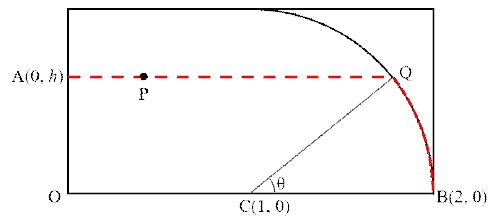
A(0,h)에서 Q까지 수평 이동하고 Q에서 B(2,0)까지 원호 이동
+25점 · 점 P\displaystyle \mathrm P가 움직이는 거리와 시간을 원호의 길이 θ\displaystyle \theta에 대한 함수로 나타내고 도함수 및 극값의 조건으로부터 시각 t=0\displaystyle t=0에서의 점 P\displaystyle \mathrm P에서의 위치를 구할 수 있다.

위의 그림과 같이 시각 t=0\displaystyle t=0에서의 점 P\displaystyle \mathrm P의 위치를 A\displaystyle \mathrm A로 나타내고 곡선 y=x2+2x\displaystyle y=\sqrt{-x^2+2x}를 만날 때의 점 P\displaystyle \mathrm P의 위치를 Q\displaystyle \mathrm Q로 나타내자.1x2\displaystyle 1\le x\le2일 때 곡선 y=x2+2x\displaystyle y=\sqrt{-x^2+2x}은 중심이 C(1,0)\displaystyle \mathrm C(1,0)이고 반지름이 1인 원의 일부이므로, 위의 그림에서 QCB=θ\displaystyle \angle\mathrm{QCB}=\theta이면 Q=(1+cosθ,sinθ)\displaystyle \mathrm Q=(1+\cos\theta,\sin\theta)이다.P\displaystyle \mathrm P가 곡선 y=x2+2x\displaystyle y=\sqrt{-x^2+2x}를 만날때의 시각을 T\displaystyle T라고 하면, 조건 (ii)에 의하여 0tT\displaystyle 0\le t\le T일 때 시각 t\displaystyle t에서의 점 P\displaystyle \mathrm Px\displaystyle x좌표는 x0+0tudu\displaystyle x_0+\int_0^t u\,du인데 x0=0\displaystyle x_0=0이므로 t22\displaystyle \frac{t^2}2이다.따라서 점 P\displaystyle \mathrm P의 시각 t\displaystyle t에서의 위치는 (t22,h)\displaystyle \left(\frac{t^2}2,h\right)이고 h=sinθ\displaystyle h=\sin\theta이다.또한 T22=1+cosθ\displaystyle \frac{T^2}2=1+\cos\theta로부터 T=2(1+cosθ)\displaystyle T=\sqrt{2(1+\cos\theta)}이다.P\displaystyle \mathrm P는 점 Q\displaystyle \mathrm Q로부터 (2,0)\displaystyle (2,0)까지 곡선 y=x2+2x\displaystyle y=\sqrt{-x^2+2x} 위를 속력 3\displaystyle \sqrt3으로 움직이는데 이때 점 P\displaystyle \mathrm P가 움직이는 거리는 rθ=θ\displaystyle r\theta=\theta이므로, 곡선 y=x2+2x\displaystyle y=\sqrt{-x^2+2x}를 움직이는데 걸리는 시간은 θ3\displaystyle \frac\theta{\sqrt3}이다.따라서 점 P\displaystyle \mathrm P(0,h)=(0,sinθ)\displaystyle (0,h)=(0,\sin\theta)를 출발하여 (2,0)\displaystyle (2,0)에 도착하는데 걸리는 시간 t(θ)\displaystyle t(\theta)t(θ)\displaystyle t(\theta)의 도함수 및 이계도함수는 각각 다음과 같다.t(θ)=2+2cosθ+θ3t(θ)=sinθ2+2cosθ+13t(θ)=2(1+cosθ)4\displaystyle \begin{aligned}t(\theta)&=\sqrt{2+2\cos\theta}+\frac\theta{\sqrt3}\\t^{\prime}(\theta)&=\frac{-\sin\theta}{\sqrt{2+2\cos\theta}}+\frac1{\sqrt3}\\t^{\prime\prime}(\theta)&=-\frac{\sqrt{2(1+\cos\theta)}}4\end{aligned}θ=θ1\displaystyle \theta=\theta_1에서 함수 t(θ)\displaystyle t(\theta)가 극값을 가질 때 t(θ1)=0\displaystyle t^{\prime}(\theta_1)=0이므로sinθ12+2cosθ1=13,sin2θ12+2cosθ1=1cos2θ12(1+cosθ1)\displaystyle \frac{\sin\theta_1}{\sqrt{2+2\cos\theta_1}}=\frac1{\sqrt3},\quad\frac{\sin^2\theta_1}{2+2\cos\theta_1}=\frac{1-\cos^2\theta_1}{2(1+\cos\theta_1)}0θ1π2\displaystyle 0\le\theta_1\le\frac\pi2이므로 1+cosθ10\displaystyle 1+\cos\theta_1\ne0이고 1cosθ12=13\displaystyle \frac{1-\cos\theta_1}2=\frac13이로부터 cosθ1=13\displaystyle \cos\theta_1=\frac13이고 sinθ1=223\displaystyle \sin\theta_1=\frac{2\sqrt2}3이다. 이때 t(θ1)\displaystyle t(\theta_1)0θπ2\displaystyle 0\le\theta\le\frac\pi2에서 유일한 극값이고, t(θ1)<0\displaystyle t^{\prime\prime}(\theta_1)<0이므로 t(θ1)\displaystyle t(\theta_1)은 극댓값이다.그러므로 t(θ)\displaystyle t(\theta)θ=θ1\displaystyle \theta=\theta_1에서 최댓값을 가지고 이때 h=sinθ1=223\displaystyle h=\sin\theta_1=\frac{2\sqrt2}3이다.

첨삭 사례

아직 등록된 첨삭 사례가 없습니다.

질문과 답변 · 0개질문과 답변 · 고정 0개

아직 등록된 질문이 없습니다. 질문 작성은 멤버십 회원만 가능합니다.