수리논술, 이게 다다.

자연계열 6번

오류 제보

문제

[문제 6, 서술형] 좌표평면 위의 점 A(−2,0)\displaystyle \mathrm{A}(-2,0)에 대해 두 점 P,Q\displaystyle \mathrm{P},\mathrm{Q}가 다음 조건을 만족시킬 때, 다음 물음에 답하시오.

(Ⅰ) AP→\displaystyle \overrightarrow{\mathrm{AP}}와 AQ→\displaystyle \overrightarrow{\mathrm{AQ}}는 서로 평행하다.

(Ⅱ) AP→⋅AQ→=9\displaystyle \overrightarrow{\mathrm{AP}}\cdot\overrightarrow{\mathrm{AQ}}=9

[문제 6-1] 점 P\displaystyle \mathrm{P}가 원 C1:x2+y2=1\displaystyle C_{1}:x^{2}+y^{2}=1 위를 움직이는 점일 때, 점 Q\displaystyle \mathrm{Q}가 나타내는 도형의 식을 구하시오. [15점]

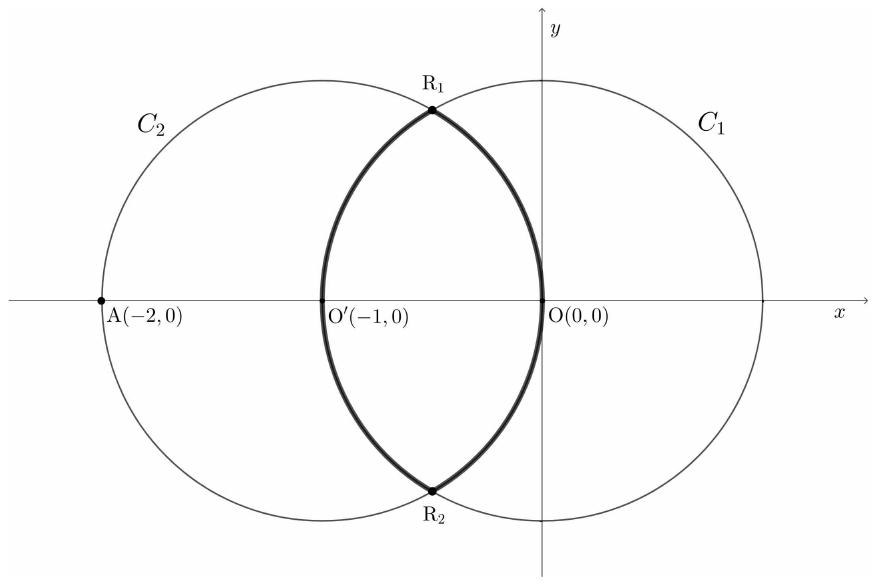
[문제 6-2] 아래 그림과 같이 두 원 C1:x2+y2=1\displaystyle C_{1}:x^{2}+y^{2}=1, C2:(x+1)2+y2=1\displaystyle C_{2}:(x+1)^{2}+y^{2}=1의 서로 다른 두 교점을 R1\displaystyle \mathrm{R}_{1}, R2\displaystyle \mathrm{R}_{2}라 하자. 원 C1\displaystyle C_{1}에서 점 O′(−1,0)\displaystyle \mathrm{O}^{\prime}(-1,0)을 포함하는 호 R1O′R2\displaystyle \mathrm{R}_{1}\mathrm{O}^{\prime}\mathrm{R}_{2}와 원 C2\displaystyle C_{2}에서 점 O(0,0)\displaystyle \mathrm{O}(0,0)을 포함하는 호 R1OR2\displaystyle \mathrm{R}_{1}\mathrm{O}\mathrm{R}_{2}로 이루어진 도형을 R\displaystyle R(아래 그림에서 굵게 표시된 도형)이라 하자. 점 P\displaystyle \mathrm{P}가 도형 R\displaystyle R 위를 움직이는 점일 때, 점 Q\displaystyle \mathrm{Q}가 나타내는 도형의 길이를 구하시오. [15점]

반지름 1인 두 원 C_1(중심 O)과 C_2(중심 O')가 겹쳐 있고 두 교점 R_1, R_2를 잇는 렌즈 모양의 경계가 굵게 그려져 있다. x축 위에 A(-2,0)이 표시되어 있다.
해설강의 준비중

벡터의 내적

관련 개념강의 준비중

위치벡터

관련 개념강의 준비중
+7점 · [6-1] 두 벡터의 조건을 좌표 또는 도형의 관계로 나타낸다.

[문제 6-1] P(x,y)\displaystyle \mathrm P(x,y), Q(X,Y)\displaystyle \mathrm Q(X,Y)라 하자.두 벡터는 평행하고 내적이 양수이므로같은 방향이며,AQ→=9∣AP→∣2AP→\displaystyle \overrightarrow{\mathrm{AQ}}=\frac9{|\overrightarrow{\mathrm{AP}}|^2}\overrightarrow{\mathrm{AP}}이다.반대로도 같은 관계가 성립하므로D=(X+2)2+Y2\displaystyle D=(X+2)^2+Y^2라 하면x+2=9(X+2)D,y=9YD\displaystyle x+2=\frac{9(X+2)}D,\qquad y=\frac{9Y}D이다.

+8점 · [6-1] 자취의 방정식을 구하고 범위를 확인한다.

이를 x2+y2=1\displaystyle x^2+y^2=1에 대입하면81D−36(X+2)D+3=0\displaystyle \frac{81}D-\frac{36(X+2)}D+3=0이므로(X−4)2+Y2=9\displaystyle (X-4)^2+Y^2=9이다.이 원에는 A\displaystyle \mathrm A가 없고 같은 식으로 원 C1\displaystyle C_1 위의 점을 복원할 수 있으므로구하는 자취는 이 원 전체이다.

+10점 · [6-2] 각 호가 만드는 자취를 범위까지 올바르게 구한다.

[문제 6-2] 두 원의 교점은 (−12,±32)\displaystyle (-\frac12,\pm\frac{\sqrt3}{2})이고,대응하는 점은 M(52,332)\displaystyle \mathrm M(\frac52,\frac{3\sqrt3}{2}), N(52,−332)\displaystyle \mathrm N(\frac52,-\frac{3\sqrt3}{2})이다.(i) 원 C2\displaystyle C_2에서는 (x+1)2+y2=1\displaystyle (x+1)^2+y^2=1이므로∣AP→∣2=2(x+2)\displaystyle |\overrightarrow{\mathrm{AP}}|^2=2(x+2)이고X=52\displaystyle X=\frac52이다.해당 호에서 Q\displaystyle \mathrm Q는 선분 MN\displaystyle \mathrm{MN}을 움직인다.(ii) 원 C1\displaystyle C_1에서는 [문제 6-1]의 원 위를 움직인다.(−1,0)\displaystyle (-1,0)은 (7,0)\displaystyle (7,0)에 대응하므로해당 자취는반지름 3\displaystyle 3이고중심각이 4π3\displaystyle \frac{4\pi}{3}인 큰 호이다.

+5점 · [6-2] 자취의 전체 길이를 올바르게 계산한다.

따라서 구하는 길이는MN‾+3⋅4π3=33+4π\displaystyle \overline{\mathrm{MN}}+3\cdot\frac{4\pi}{3}=3\sqrt3+4\pi이다.

다른 타당한 풀이도 해당 단계의 논증과 계산이 옳으면 같은 배점을 인정한다.

첨삭 사례

아직 등록된 첨삭 사례가 없습니다.

질문과 답변 · 0개질문과 답변 · 고정 0개

아직 등록된 질문이 없습니다. 질문 작성은 멤버십 회원만 가능합니다.