수리논술, 배움에서 논증의 완성까지.

자연계열 1번

문제

🔒
짧은 시간에 너무 많은 문제를 여셔서 열람을 잠시 제한했습니다. 잠시 후 다시 시도하시거나 로그인해 주세요.
해설강의 준비중

논제 1.

+5점 · 타원 x216+y27=1\displaystyle \frac{x^2}{16}+\frac{y^2}{7}=1의 두 초점은 F(3,0),  F(3,0)\displaystyle \mathrm{F}(3,0),\;\mathrm{F}^{\prime}(-3,0)이다. +5점 · 타원 위의 점 A\displaystyle \mathrm{A}A=(x,y)\displaystyle \mathrm{A}=(x,y)라 하면 AF\displaystyle \overrightarrow{\mathrm{AF}}AF\displaystyle \overrightarrow{\mathrm{AF}^{\prime}}는 각각 (3x,y),  (3x,y)\displaystyle (3-x,-y),\;(-3-x,-y)이고, 따라서AFAF=(3x,y)(3x,y)=x2+y29\displaystyle \overrightarrow{\mathrm{AF}}\cdot\overrightarrow{\mathrm{AF}^{\prime}}=(3-x,-y)\cdot(-3-x,-y)=x^2+y^2-9이다. +5점 · AFAF=x2+y29=k\displaystyle \overrightarrow{\mathrm{AF}}\cdot\overrightarrow{\mathrm{AF}^{\prime}}=x^2+y^2-9=k로 두면 점 A\displaystyle \mathrm{A}는 중심이 원점이고 반지름이 k+9\displaystyle \sqrt{k+9}인 원위를 움직인다. 이 때, AFAF\displaystyle \overrightarrow{\mathrm{AF}}\cdot\overrightarrow{\mathrm{AF}^{\prime}}k+9=7\displaystyle \sqrt{k+9}=\sqrt7일 때 최솟값, k+9=4\displaystyle \sqrt{k+9}=4일때 최댓값을 갖는다. 따라서, M=7,  m=2\displaystyle M=7,\;m=-2이다.

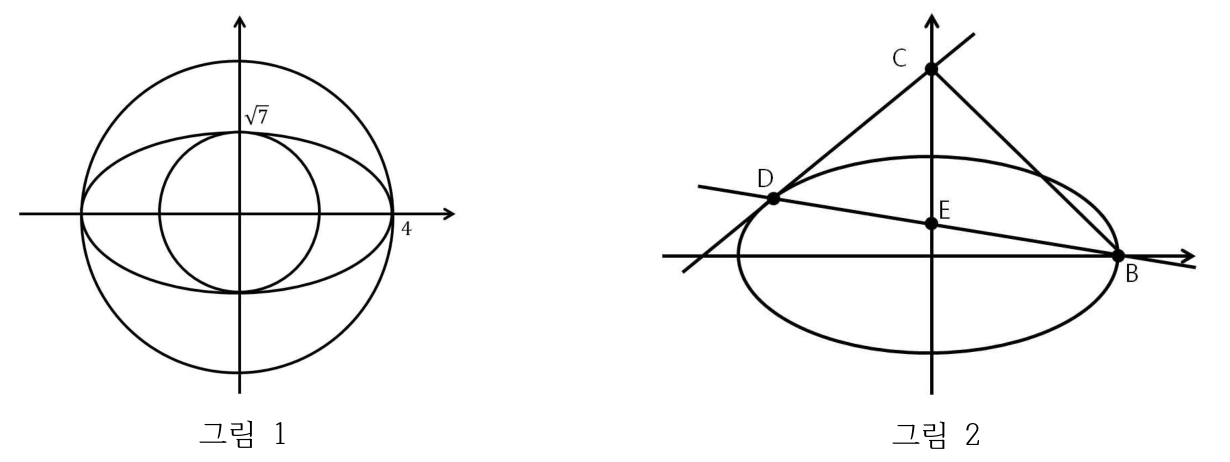
타원 x216+y27=1\displaystyle \frac{x^2}{16}+\frac{y^2}{7}=1의 두 초점은 F(3,0),  F(3,0)\displaystyle \mathrm{F}(3,0),\;\mathrm{F}^{\prime}(-3,0)이다. 타원 위의 점 A\displaystyle \mathrm{A}A=(x,y)\displaystyle \mathrm{A}=(x,y)라 하면 AF\displaystyle \overrightarrow{\mathrm{AF}}AF\displaystyle \overrightarrow{\mathrm{AF}^{\prime}}는 각각 (3x,y),  (3x,y)\displaystyle (3-x,-y),\;(-3-x,-y)이고, 따라서AFAF=(3x,y)(3x,y)=x2+y29\displaystyle \overrightarrow{\mathrm{AF}}\cdot\overrightarrow{\mathrm{AF}^{\prime}}=(3-x,-y)\cdot(-3-x,-y)=x^2+y^2-9이다. AFAF=x2+y29=k\displaystyle \overrightarrow{\mathrm{AF}}\cdot\overrightarrow{\mathrm{AF}^{\prime}}=x^2+y^2-9=k로 두면 점 A\displaystyle \mathrm{A}는 중심이 원점이고 반지름이 k+9\displaystyle \sqrt{k+9}인 원위를 움직인다. 이 때, AFAF\displaystyle \overrightarrow{\mathrm{AF}}\cdot\overrightarrow{\mathrm{AF}^{\prime}}k+9=7\displaystyle \sqrt{k+9}=\sqrt7일 때 최솟값, k+9=4\displaystyle \sqrt{k+9}=4일때 최댓값을 갖는다. (그림 1 참조) 따라서, M=7,  m=2\displaystyle M=7,\;m=-2이다.

그림 1 타원과 동심원, 그림 2 타원의 접선과 삼각형 BCD

논제 2.

+5점 · 점 B(4,0)\displaystyle \mathrm{B}(4,0)이 꼭짓점이고 F(3,0)\displaystyle \mathrm{F}(3,0)이 초점인 포물선은 원점이 꼭짓점이고 (1,0)\displaystyle (-1,0)이 초점인 포물선 y2=4x\displaystyle y^2=-4xx\displaystyle x축으로 4\displaystyle 4만큼 평행이동시킨 y2=4(x4)\displaystyle y^2=-4(x-4)이다.

B(4,0)\displaystyle \mathrm{B}(4,0)이 꼭짓점이고 F(3,0)\displaystyle \mathrm{F}(3,0)이 초점인 포물선은 원점이 꼭짓점이고 (1,0)\displaystyle (-1,0)이 초점인 포물선 y2=4x\displaystyle y^2=-4xx\displaystyle x축으로 4\displaystyle 4만큼 평행이동시킨 y2=4(x4)\displaystyle y^2=-4(x-4)이다.

+5점 · 이 포물선이 y\displaystyle y축과 만나는 점의 y\displaystyle y좌표는 y2=4(04)\displaystyle y^2=-4(0-4)에서 y=±4\displaystyle y=\pm4이고, 이 중 y\displaystyle y좌표가 양수인 점 C\displaystyle \mathrm{C}(0,4)\displaystyle (0,4)이다. 한편, 점 C\displaystyle \mathrm{C}에서 타원 x216+y27=1\displaystyle \frac{x^2}{16}+\frac{y^2}{7}=1에 그은 접선이 타원과 만나는 점을 D(x1,y1)\displaystyle \mathrm{D}(x_1,y_1)이라 하면, 점 D\displaystyle \mathrm{D}는 다음 두 식을 만족한다.0x116+4y17=1,x1216+y127=1\displaystyle \frac{0x_1}{16}+\frac{4y_1}{7}=1,\quad\frac{x_1^2}{16}+\frac{y_1^2}{7}=1이 두 식을 만족하는 점은 (x1,y1)=(3,74),(3,74)\displaystyle (x_1,y_1)=\left(-3,\frac74\right),\left(3,\frac74\right)이고, 이 중 접선의 기울기가 양수인 점 D\displaystyle \mathrm{D}(3,74)\displaystyle \left(-3,\frac74\right)이다.

이 포물선이 y\displaystyle y축과 만나는 점의 y\displaystyle y좌표는 y2=4(04)\displaystyle y^2=-4(0-4)에서 y=±4\displaystyle y=\pm4이고, 이 중 y\displaystyle y좌표가 양수인 점 C\displaystyle \mathrm{C}(0,4)\displaystyle (0,4)이다. 한편, 점 C\displaystyle \mathrm{C}에서 타원 x216+y27=1\displaystyle \frac{x^2}{16}+\frac{y^2}{7}=1에 그은 접선이 타원과 만나는 점을 D(x1,y1)\displaystyle \mathrm{D}(x_1,y_1)이라 하면, 점 D\displaystyle \mathrm{D}는 다음 두 식을 만족한다.0x116+4y17=1,x1216+y127=1\displaystyle \frac{0x_1}{16}+\frac{4y_1}{7}=1,\quad\frac{x_1^2}{16}+\frac{y_1^2}{7}=1이 두 식을 만족하는 점은 (x1,y1)=(3,74),(3,74)\displaystyle (x_1,y_1)=\left(-3,\frac74\right),\left(3,\frac74\right)이고, 이 중 접선의 기울기가 양수인 점 D\displaystyle \mathrm{D}(3,74)\displaystyle \left(-3,\frac74\right)이다.

+5점 · 점 B\displaystyle \mathrm{B}D\displaystyle \mathrm{D}를 지나는 직선은 y=14(x4)\displaystyle y=-\frac14(x-4)이고 이 직선과 y\displaystyle y축이 만나는 점 (0,1)\displaystyle (0,1)E\displaystyle \mathrm{E}라 두면, 삼각형 BCD\displaystyle \mathrm{BCD}의 넓이는 삼각형 BCE\displaystyle \mathrm{BCE}의 넓이와 삼각형 CDE\displaystyle \mathrm{CDE}의 넓이의 합이다. 따라서, 삼각형 BCD\displaystyle \mathrm{BCD}의 넓이는 12(3×3+3×4)=212\displaystyle \frac12(3\times3+3\times4)=\frac{21}{2}이다.

B\displaystyle \mathrm{B}D\displaystyle \mathrm{D}를 지나는 직선은 y=14(x4)\displaystyle y=-\frac14(x-4)이고 이 직선과 y\displaystyle y축이 만나는 점 (0,1)\displaystyle (0,1)E\displaystyle \mathrm{E}라 두면, 삼각형 BCD\displaystyle \mathrm{BCD}의 넓이는 삼각형 BCE\displaystyle \mathrm{BCE}의 넓이와 삼각형 CDE\displaystyle \mathrm{CDE}의 넓이의 합이다. 따라서, 삼각형 BCD\displaystyle \mathrm{BCD}의 넓이는 12(3×3+3×4)=212\displaystyle \frac12(3\times3+3\times4)=\frac{21}{2}이다. (그림 2 참조)

첨삭 사례

아직 등록된 첨삭 사례가 없습니다.

질문과 답변 · 0개질문과 답변 · 고정 0개

아직 등록된 질문이 없습니다. 질문 작성은 멤버십 회원만 가능합니다.