수리논술, 이게 다다.

자연계열 1번

오류 제보

문제

[가] 좌표평면의 원점 O와 점 P(x,y)\displaystyle \mathrm P(x,y)에 대하여, 동경 OP가 나타내는 각의 크기를 θ\displaystyle \theta, OP‾\displaystyle \overline{\mathrm{OP}}를 r\displaystyle r이라 하면sin⁡θ=yr, cos⁡θ=xr, tan⁡θ=yx (x≠0), csc⁡θ=ry (y≠0), sec⁡θ=rx (x≠0), cot⁡θ=xy (y≠0)\displaystyle \sin\theta=\frac yr,\ \cos\theta=\frac xr,\ \tan\theta=\frac yx\ (x\ne0),\ \csc\theta=\frac ry\ (y\ne0),\ \sec\theta=\frac rx\ (x\ne0),\ \cot\theta=\frac xy\ (y\ne0)

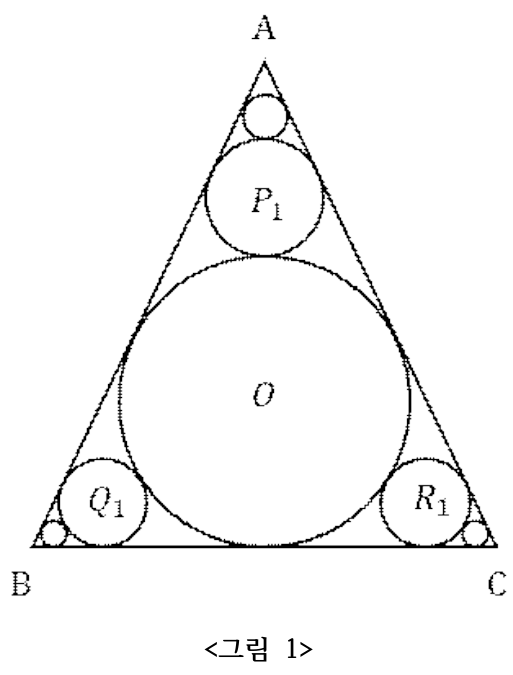
[논제 Ⅰ]AB‾=AC‾\displaystyle \overline{AB}=\overline{AC}인 이등변삼각형 ABC의 내접원 O의 반지름을 1이라 하고 <그림 1>과 같이 두 변과 내접원 O에 모두 접하는 원을 각각 P1, Q1, R1\displaystyle P_1,\ Q_1,\ R_1이라 하자. 자연수 n\displaystyle n에 대하여 원 Pn+1\displaystyle P_{n+1}은 원 Pn\displaystyle P_n과 두 변 AB, AC에 접하고, 원 Pn+1\displaystyle P_{n+1}의 반지름은 원 Pn\displaystyle P_n의 반지름보다 작다. 원 Qn+1\displaystyle Q_{n+1}은 원 Qn\displaystyle Q_n과 두 변 AB, BC에 접하고, 원 Qn+1\displaystyle Q_{n+1}의 반지름은 원 Qn\displaystyle Q_n의 반지름보다 작다. 원 Rn+1\displaystyle R_{n+1}은 원 Rn\displaystyle R_n과 두 변 BC, AC에 접하고, 원 Rn+1\displaystyle R_{n+1}의 반지름은 원 Rn\displaystyle R_n의 반지름보다 작다. 각 B의 크기를 θ\displaystyle \theta라고 할 때, 다음 물음에 답하시오.

그림 1: 이등변삼각형 안에서 두 변에 접하는 원들

(1) 모든 원의 둘레의 합을 f(θ)=c1sec⁡d1θ+c2csc⁡d2θ+c3\displaystyle f(\theta)=c_1\sec d_1\theta+c_2\csc d_2\theta+c_3의 꼴로 나타내고, 그 근거를 논술하시오. (단, c1, c2, c3, d1, d2\displaystyle c_1,\ c_2,\ c_3,\ d_1,\ d_2는 실수이다.) (15점)

(2) 삼각형 ABC의 세 변의 길이의 합 g(θ)\displaystyle g(\theta)와 극한값 lim⁡θ→0f(θ)g(θ), lim⁡θ→π2f(θ)g(θ)\displaystyle \lim_{\theta\to0}\frac{f(\theta)}{g(\theta)},\ \lim_{\theta\to\frac\pi2}\frac{f(\theta)}{g(\theta)}를 구하시오. 그리고 그 근거를 논술하시오. (10점)

해설강의 준비중

논술 직선에 접하는 원의 배치

관련 개념강의 준비중
+5점 · 원 Pn\displaystyle P_n의 둘레의 길이에 관한 등비급수를 구한다.

(1) 각 B와 각 C의 크기를 θ\displaystyle \theta라 하면, 각 A의 크기는 π−2θ\displaystyle \pi-2\theta이다. 원 P1\displaystyle P_1의 반지름 p1\displaystyle p_1은 1−p11+p1=sin⁡(π2−θ)=cos⁡θ\displaystyle \frac{1-p_1}{1+p_1}=\sin\left(\frac\pi2-\theta\right)=\cos\theta에서 p1=1−cos⁡θ1+cos⁡θ\displaystyle p_1=\frac{1-\cos\theta}{1+\cos\theta}이므로, 일반적으로 원 Pn\displaystyle P_n의 반지름 pn\displaystyle p_n은 공비가 1−cos⁡θ1+cos⁡θ\displaystyle \frac{1-\cos\theta}{1+\cos\theta}인 등비수열이다.

+5점 · 원 Qn\displaystyle Q_n 또는 원 Rn\displaystyle R_n의 둘레의 길이에 관한 등비급수를 구한다.

마찬가지로 원 Q1\displaystyle Q_1의 반지름 q1\displaystyle q_1은 sin⁡θ2=1−q11+q1\displaystyle \sin\frac\theta2=\frac{1-q_1}{1+q_1}에서 q1=1−sin⁡θ21+sin⁡θ2\displaystyle q_1=\frac{1-\sin\frac\theta2}{1+\sin\frac\theta2}이므로, 일반적으로 원 Qn\displaystyle Q_n의 반지름 qn\displaystyle q_n은 공비가 1−sin⁡θ21+sin⁡θ2\displaystyle \frac{1-\sin\frac\theta2}{1+\sin\frac\theta2}인 등비수열이다. 원 Rn\displaystyle R_n의 반지름 rn\displaystyle r_n은 qn\displaystyle q_n과 같다.

+5점 · 모든 원의 둘레의 길이를 요구하는 형태로 표현할 수 있다.

따라서, 모든 원의 둘레의 합은 내접원 O의 둘레를 첫째항으로 하는 등비급수의 합을 이용하여 계산하면f(θ)=2π1−1−cos⁡θ1+cos⁡θ+22π1−1−sin⁡θ21+sin⁡θ2−4π=π(1+cos⁡θ)cos⁡θ+2π(1+sin⁡θ2)sin⁡θ2−4π=πsec⁡θ+2πcsc⁡θ2−π\displaystyle \begin{aligned}f(\theta)&=\frac{2\pi}{1-\frac{1-\cos\theta}{1+\cos\theta}}+2\frac{2\pi}{1-\frac{1-\sin\frac\theta2}{1+\sin\frac\theta2}}-4\pi\\&=\frac{\pi(1+\cos\theta)}{\cos\theta}+\frac{2\pi\left(1+\sin\frac\theta2\right)}{\sin\frac\theta2}-4\pi\\&=\pi\sec\theta+2\pi\csc\frac\theta2-\pi\end{aligned}이다.

+5점 · 삼각형의 세 변의 길이의 합을 각 θ\displaystyle \theta로 표현할 수 있다.

(2) 삼각형의 세 변의 길이의 합은 내접원의 중심에서 각 변에 수선의 발을 내려, 꼭짓점에서 그 수선의 발까지의 거리의 합을 이용하여 계산할 수 있다. g(θ)=2tan⁡θ+4cot⁡θ2\displaystyle g(\theta)=2\tan\theta+4\cot\frac\theta2이다.

+5점 · 길이의 비의 극한값을 계산할 수 있다.

f(θ)g(θ)=πsec⁡θ+2πcsc⁡θ2−π2tan⁡θ+4cot⁡θ2=πsin⁡θ2sec⁡θ+2π−πsin⁡θ22sin⁡θ2tan⁡θ+4cos⁡θ2\displaystyle \frac{f(\theta)}{g(\theta)}=\frac{\pi\sec\theta+2\pi\csc\frac\theta2-\pi}{2\tan\theta+4\cot\frac\theta2}=\frac{\pi\sin\frac\theta2\sec\theta+2\pi-\pi\sin\frac\theta2}{2\sin\frac\theta2\tan\theta+4\cos\frac\theta2}이고, θ→0\displaystyle \theta\to0이면πsin⁡θ2sec⁡θ+2π−πsin⁡θ22sin⁡θ2tan⁡θ+4cos⁡θ2→0+2π−00+4=π2\displaystyle \frac{\pi\sin\frac\theta2\sec\theta+2\pi-\pi\sin\frac\theta2}{2\sin\frac\theta2\tan\theta+4\cos\frac\theta2}\to\frac{0+2\pi-0}{0+4}=\frac\pi2이므로, lim⁡θ→0f(θ)g(θ)=π2\displaystyle \lim_{\theta\to0}\frac{f(\theta)}{g(\theta)}=\frac\pi2이다.또한,f(θ)g(θ)=πsec⁡θ+2πcsc⁡θ2−π2tan⁡θ+4cot⁡θ2=π+2πcos⁡θcsc⁡θ2−πcos⁡θ2sin⁡θ+4cos⁡θcot⁡θ2\displaystyle \frac{f(\theta)}{g(\theta)}=\frac{\pi\sec\theta+2\pi\csc\frac\theta2-\pi}{2\tan\theta+4\cot\frac\theta2}=\frac{\pi+2\pi\cos\theta\csc\frac\theta2-\pi\cos\theta}{2\sin\theta+4\cos\theta\cot\frac\theta2}이고,θ→π2\displaystyle \theta\to\frac\pi2이면 π+2πcos⁡θcsc⁡θ2−πcos⁡θ2sin⁡θ+4cos⁡θcot⁡θ2→π+0−02+0=π2\displaystyle \frac{\pi+2\pi\cos\theta\csc\frac\theta2-\pi\cos\theta}{2\sin\theta+4\cos\theta\cot\frac\theta2}\to\frac{\pi+0-0}{2+0}=\frac\pi2이므로, lim⁡θ→π2f(θ)g(θ)=π2\displaystyle \lim_{\theta\to\frac\pi2}\frac{f(\theta)}{g(\theta)}=\frac\pi2이다.

첨삭 사례

아직 등록된 첨삭 사례가 없습니다.

질문과 답변 · 0개질문과 답변 · 고정 0개

아직 등록된 질문이 없습니다. 질문 작성은 멤버십 회원만 가능합니다.