+40점 · G ( x ) \displaystyle G(x) G ( x ) x = 1 \displaystyle x=1 x = 1 (3-1) G ( x ) = ∫ 1 x g ( t ) d t \displaystyle G(x)=\int_1^xg(t)\,dt G ( x ) = ∫ 1 x g ( t ) d t G ( x ) \displaystyle G(x) G ( x ) x \displaystyle x x G ( x ) ≥ 0 \displaystyle G(x)\ge0 G ( x ) ≥ 0 G ( 1 ) = 0 \displaystyle G(1)=0 G ( 1 ) = 0 G ( x ) \displaystyle G(x) G ( x ) x = 1 \displaystyle x=1 x = 1 0 \displaystyle 0 0
+30점 · g ( 1 ) = G ′ ( 1 ) = 0 \displaystyle g(1)=G\prime(1)=0 g ( 1 ) = G ′ ( 1 ) = 0 그런데 는 미분가능한 함수이므로 G ′ ( 1 ) = 0 \displaystyle G\prime(1)=0 G ′ ( 1 ) = 0 G ′ ( x ) = g ( x ) \displaystyle G\prime(x)=g(x) G ′ ( x ) = g ( x ) g ( 1 ) = G ′ ( 1 ) = 0 \displaystyle g(1)=G\prime(1)=0 g ( 1 ) = G ′ ( 1 ) = 0
+10점 · f ( 1 ) = 0 \displaystyle f(1)=0 f ( 1 ) = 0 f ( x ) = g ( x ) e − x \displaystyle f(x)=g(x)e^{-x} f ( x ) = g ( x ) e − x f ( 1 ) = g ( 1 ) e − 1 = 0 \displaystyle f(1)=g(1)e^{-1}=0 f ( 1 ) = g ( 1 ) e − 1 = 0
+30점 · 방정식 f ( x ) = 0 \displaystyle f(x)=0 f ( x ) = 0 x = 3 \displaystyle x=3 x = 3 f ′ ( 3 ) = 0 \displaystyle f\prime(3)=0 f ′ ( 3 ) = 0 (3-2) (3-1)의 결과와 조건 (나)로부터 f ( 1 ) = f ( 3 ) = 0 \displaystyle f(1)=f(3)=0 f ( 1 ) = f ( 3 ) = 0 f ( x ) = 0 \displaystyle f(x)=0 f ( x ) = 0 x = 3 \displaystyle x=3 x = 3 x = 3 \displaystyle x=3 x = 3 g ( x ) \displaystyle g(x) g ( x ) g ( x ) \displaystyle g(x) g ( x ) x = 3 \displaystyle x=3 x = 3 f ( x ) = ( x − 1 ) ( x − 3 ) 2 \displaystyle f(x)=(x-1)(x-3)^2 f ( x ) = ( x − 1 ) ( x − 3 ) 2
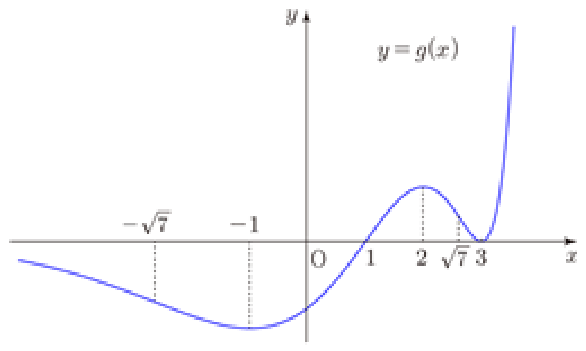
+5점 · g ( x ) \displaystyle g(x) g ( x ) x = 2 \displaystyle x=2 x = 2 +5점 · x = − 1 \displaystyle x=-1 x = − 1 +5점 · x = 3 \displaystyle x=3 x = 3 +5점 · x = 1 \displaystyle x=1 x = 1 +5점 · x = − 7 \displaystyle x=-\sqrt7 x = − 7 +5점 · x = 7 \displaystyle x=\sqrt7 x = 7 이 때 g ( x ) = ( x − 1 ) ( x − 3 ) 2 e x \displaystyle g(x)=(x-1)(x-3)^2e^x g ( x ) = ( x − 1 ) ( x − 3 ) 2 e x g ′ ( x ) = ( x + 1 ) ( x − 2 ) ( x − 3 ) e x \displaystyle g\prime(x)=(x+1)(x-2)(x-3)e^x g ′ ( x ) = ( x + 1 ) ( x − 2 ) ( x − 3 ) e x g ′ ′ ( x ) = ( x − 1 ) ( x 2 − 7 ) e x \displaystyle g\prime\prime(x)=(x-1)(x^2-7)e^x g ′′ ( x ) = ( x − 1 ) ( x 2 − 7 ) e x g ( x ) \displaystyle g(x) g ( x ) x = − 1 \displaystyle x=-1 x = − 1 3 \displaystyle 3 3 x = 2 \displaystyle x=2 x = 2 x = 1 \displaystyle x=1 x = 1 ± 7 \displaystyle \pm\sqrt7 ± 7
+20점 · y = g ( x ) \displaystyle y=g(x) y = g ( x ) g ( 1 ) = g ( 3 ) = 0 \displaystyle g(1)=g(3)=0 g ( 1 ) = g ( 3 ) = 0 x < 1 \displaystyle x<1 x < 1 g ( x ) < 0 \displaystyle g(x)<0 g ( x ) < 0 y = g ( x ) \displaystyle y=g(x) y = g ( x )
+20점 · 주어진 방정식이 g ′ ( t ) ( x − t ) + g ( t ) = g ( x + 1 ) \displaystyle g\prime(t)(x-t)+g(t)=g(x+1) g ′ ( t ) ( x − t ) + g ( t ) = g ( x + 1 ) x ≠ t \displaystyle x\ne t x = t h ( t ) \displaystyle h(t) h ( t ) y = g ( x ) \displaystyle y=g(x) y = g ( x ) ( t , g ( t ) ) \displaystyle (t,g(t)) ( t , g ( t )) y = g ( x + 1 ) \displaystyle y=g(x+1) y = g ( x + 1 ) ( t , g ( t ) ) \displaystyle (t,g(t)) ( t , g ( t )) (3-3) 방정식 g ′ ( t ) = g ( x + 1 ) − g ( t ) x − t \displaystyle g\prime(t)=\frac{g(x+1)-g(t)}{x-t} g ′ ( t ) = x − t g ( x + 1 ) − g ( t ) g ′ ( t ) ( x − t ) + g ( t ) = g ( x + 1 ) \displaystyle g\prime(t)(x-t)+g(t)=g(x+1) g ′ ( t ) ( x − t ) + g ( t ) = g ( x + 1 ) x ≠ t \displaystyle x\ne t x = t h ( t ) \displaystyle h(t) h ( t ) y = g ( x ) \displaystyle y=g(x) y = g ( x ) ( t , g ( t ) ) \displaystyle (t,g(t)) ( t , g ( t )) y = g ( x + 1 ) \displaystyle y=g(x+1) y = g ( x + 1 ) ( t , g ( t ) ) \displaystyle (t,g(t)) ( t , g ( t ))
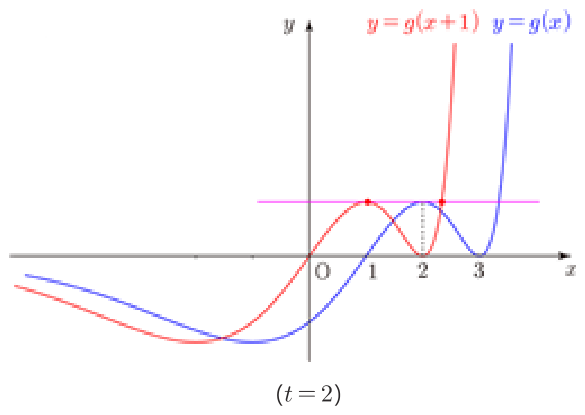
+10점 · 좌표평면에 y = g ( x ) \displaystyle y=g(x) y = g ( x ) y = g ( x + 1 ) \displaystyle y=g(x+1) y = g ( x + 1 ) +10점 · h ( 2 ) = 2 \displaystyle h(2)=2 h ( 2 ) = 2 그래프를 이용하여 구간 [ 2 , 3 ] \displaystyle [2,3] [ 2 , 3 ] t \displaystyle t t h ( t ) = 2 \displaystyle h(t)=2 h ( t ) = 2 t \displaystyle t t t = 2 \displaystyle t=2 t = 2 ( 2 , g ( 2 ) ) \displaystyle (2,g(2)) ( 2 , g ( 2 )) y = g ( x + 1 ) \displaystyle y=g(x+1) y = g ( x + 1 ) x \displaystyle x x 2 \displaystyle 2 2 h ( 2 ) = 2 \displaystyle h(2)=2 h ( 2 ) = 2
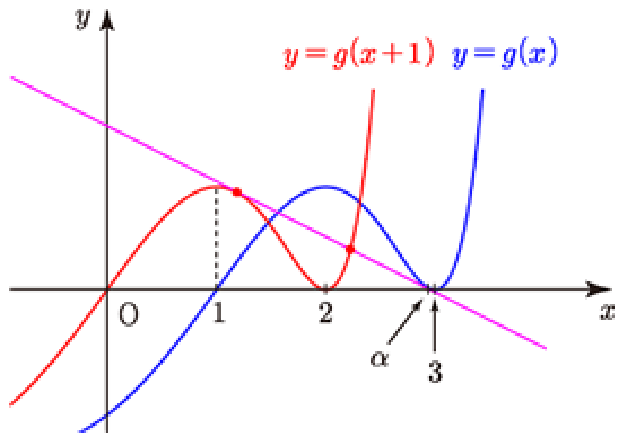
+10점 · 곡선 y = g ( x ) \displaystyle y=g(x) y = g ( x ) ( α , g ( α ) ) \displaystyle (\alpha,g(\alpha)) ( α , g ( α )) y = g ( x + 1 ) \displaystyle y=g(x+1) y = g ( x + 1 ) α \displaystyle \alpha α x \displaystyle x x = 7 \displaystyle =\sqrt7 = 7 3 \displaystyle 3 3 이제 t > 2 \displaystyle t>2 t > 2 t \displaystyle t t y = g ( x ) \displaystyle y=g(x) y = g ( x ) ( t , g ( t ) ) \displaystyle (t,g(t)) ( t , g ( t )) ( 7 , g ( 7 ) ) \displaystyle (\sqrt7,g(\sqrt7)) ( 7 , g ( 7 )) y = g ( x + 1 ) \displaystyle y=g(x+1) y = g ( x + 1 ) y = g ( x + 1 ) \displaystyle y=g(x+1) y = g ( x + 1 ) y = g ( x ) \displaystyle y=g(x) y = g ( x ) ( α , g ( α ) ) \displaystyle (\alpha,g(\alpha)) ( α , g ( α )) y = g ( x + 1 ) \displaystyle y=g(x+1) y = g ( x + 1 ) α \displaystyle \alpha α 7 \displaystyle \sqrt7 7 3 \displaystyle 3 3 y = g ( x + 1 ) \displaystyle y=g(x+1) y = g ( x + 1 )
+10점 · g ( α ) < g ( α + 1 ) \displaystyle g(\alpha)<g(\alpha+1) g ( α ) < g ( α + 1 ) h ( α ) = 2 \displaystyle h(\alpha)=2 h ( α ) = 2 이 경우 5 2 < 7 < α < 3 \displaystyle \frac52<\sqrt7<\alpha<3 2 5 < 7 < α < 3 ( α − 3 ) 2 < ( α − 2 ) 2 \displaystyle (\alpha-3)^2<(\alpha-2)^2 ( α − 3 ) 2 < ( α − 2 ) 2 g ( α ) = ( α − 1 ) ( α − 3 ) 2 e α < α ( α − 2 ) 2 e α + 1 = g ( α + 1 ) \displaystyle g(\alpha)=(\alpha-1)(\alpha-3)^2e^\alpha<\alpha(\alpha-2)^2e^{\alpha+1}=g(\alpha+1) g ( α ) = ( α − 1 ) ( α − 3 ) 2 e α < α ( α − 2 ) 2 e α + 1 = g ( α + 1 ) 따라서 아래 그림에서 점 ( α , g ( α ) ) \displaystyle (\alpha,g(\alpha)) ( α , g ( α )) y = g ( x + 1 ) \displaystyle y=g(x+1) y = g ( x + 1 ) x \displaystyle x x α \displaystyle \alpha α 2 < t < α \displaystyle 2<t<\alpha 2 < t < α h ( t ) ≤ 1 \displaystyle h(t)\le1 h ( t ) ≤ 1 h ( α ) = 2 \displaystyle h(\alpha)=2 h ( α ) = 2
α < t < 3 \displaystyle \alpha<t<3 α < t < 3 y = g ( x ) \displaystyle y=g(x) y = g ( x ) ( t , g ( t ) ) \displaystyle (t,g(t)) ( t , g ( t )) y = g ( x + 1 ) \displaystyle y=g(x+1) y = g ( x + 1 ) x \displaystyle x x t \displaystyle t t h ( t ) = 3 \displaystyle h(t)=3 h ( t ) = 3
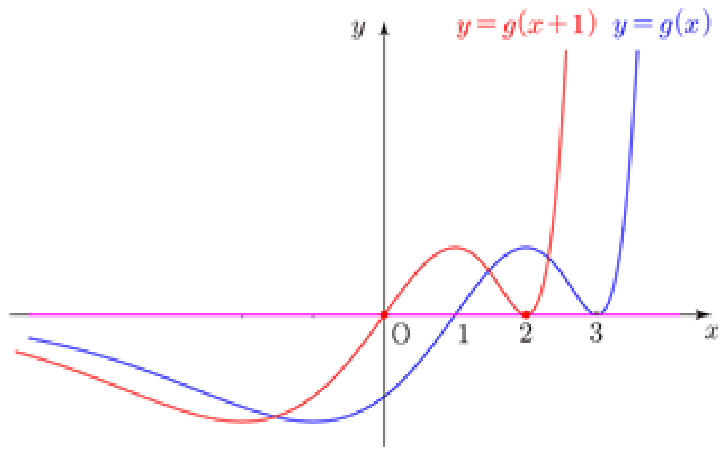
+10점 · h ( 3 ) = 2 \displaystyle h(3)=2 h ( 3 ) = 2 t = 3 \displaystyle t=3 t = 3 ( 3 , g ( 3 ) ) \displaystyle (3,g(3)) ( 3 , g ( 3 )) y = g ( x + 1 ) \displaystyle y=g(x+1) y = g ( x + 1 ) x \displaystyle x x 3 \displaystyle 3 3 h ( 3 ) = 2 \displaystyle h(3)=2 h ( 3 ) = 2
+10점 · h ( t ) = 2 \displaystyle h(t)=2 h ( t ) = 2 t \displaystyle t t 결국 h ( t ) = 2 \displaystyle h(t)=2 h ( t ) = 2 t ∈ [ 2 , 3 ] \displaystyle t\in[2,3] t ∈ [ 2 , 3 ] t = 2 \displaystyle t=2 t = 2 α \displaystyle \alpha α 3 \displaystyle 3 3 h ( t ) = 2 \displaystyle h(t)=2 h ( t ) = 2 t \displaystyle t t 3 \displaystyle 3 3
(3-1) 배점: 70점 Correction. (3-1) 채점표 배점 칸의 70점은 80점의 오기로 보인다. 문제 본문은 80점이며, 채점 항목 40점·30점·10점의 합도 80점이다. 원문 표기는 그대로 실었다.
[참고] “( t , g ( t ) ) \displaystyle (t,g(t)) ( t , g ( t ))
[참고] α \displaystyle \alpha α
 수리논술, 배움에서 논증의 완성까지.