수리논술, 배움에서 논증의 완성까지.

수리형 2교시 3번

문제

🔒
짧은 시간에 너무 많은 문제를 여셔서 열람을 잠시 제한했습니다. 잠시 후 다시 시도하시거나 로그인해 주세요.
해설강의 준비중

[문제 3-ⅰ]

+10점 · 제시문에 주어진 함수의 합성함수와 관련된 부등식의 해로 이루어진 집합을 제대로 구할 수 있다.

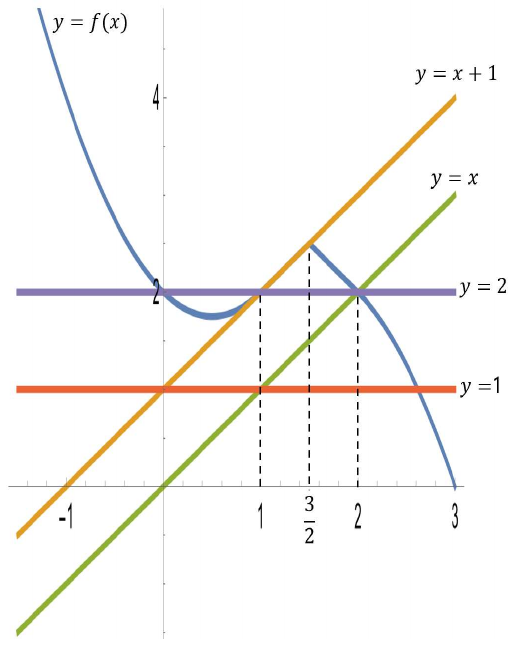
곡선 y=f(x)\displaystyle y=f(x)의 그래프는 오른쪽 그림과 같다.f(x)\displaystyle f(x)t\displaystyle t로 치환하면, f(f(x))f(x)+1\displaystyle f(f(x))\le f(x)+1이라는 조건은 f(t)t+1\displaystyle f(t)\le t+1이 된다. 곡선 y=f(x)\displaystyle y=f(x)의 그래프와 직선 y=x+1\displaystyle y=x+1의 그래프를 비교해보면, f(t)t+1\displaystyle f(t)\le t+1이 되는 t\displaystyle t의 범위는 t1\displaystyle t\ge1임을 알 수 있다. 〈제시문1〉에 주어진 함수의 정의로부터 f(x)1\displaystyle f(x)\ge1이 되는 x\displaystyle x의 범위를 조사해 보면, x2+3x=1\displaystyle -x^{2}+3x=1의 두 실근 중에서 더 큰 실근을 a\displaystyle a라고 했을 때, xa\displaystyle x\le a가 된다. 여기서 a=3+52\displaystyle a=\frac{3+\sqrt{5}}{2}이므로, 집합 D1=(,a]\displaystyle D_{1}=(-\infty,a]일 때, a=3+52\displaystyle a=\frac{3+\sqrt{5}}{2}이다.비슷한 방법으로, f(f(x))f(x)\displaystyle f(f(x))\le f(x)라는 조건은 f(t)t\displaystyle f(t)\le t이 된다. 곡선 y=f(x)\displaystyle y=f(x)의 그래프와 직선 y=x\displaystyle y=x의 그래프를 비교해보면, f(t)t\displaystyle f(t)\le t이 되는 t\displaystyle t의 범위는 t2\displaystyle t\ge2임을 알 수 있다. 〈제시문1〉에 주어진 함수의 정의로부터 f(x)2\displaystyle f(x)\ge2이 되는 x\displaystyle x의 범위를 조사해 보면, x0\displaystyle x\le0 이거나 1x2\displaystyle 1\le x\le2임을 알 수 있다. 따라서 집합 D2=(,b][c,d]\displaystyle D_{2}=(-\infty,b]\cup[c,d]일 때, b=0\displaystyle b=0, c=1\displaystyle c=1, d=2\displaystyle d=2가 된다.답: a=3+52\displaystyle a=\frac{3+\sqrt{5}}{2}, b=0\displaystyle b=0, c=1\displaystyle c=1, d=2\displaystyle d=2

곡선 y=f(x)와 직선 y=x+1, y=x, 그리고 수평선 y=2, y=1을 한 좌표평면에 그린 그림. x=1, 3/2, 2 자리에 점선이 세워져 있다.

[문제 3-ⅱ]

+15점 · 제시문에 주어진 함수의 그래프를 그리고, 그래프 밖에 있는 한 원의 특정한 점을 지나는 직선이 그래프의 특정한 부분을 지날 때, 원에 생기는 호의 길이를 제대로 구할 수 있다.

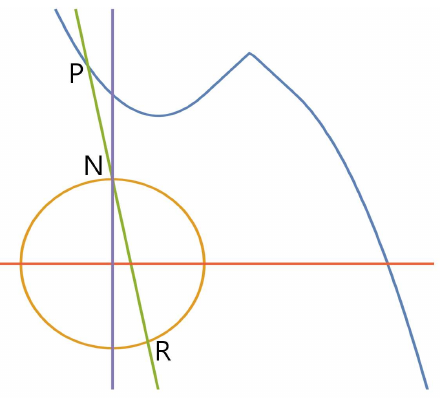
문제에 주어진 상황을 그림으로 나타내면 오른쪽 그림과 같다.N\displaystyle \mathrm{N}과 점 P\displaystyle \mathrm{P}를 지나는 직선의 기울기를 m\displaystyle m이라고 하자. 먼저 점 (0,1)\displaystyle (0,1)을 지나고 y=x2x+2\displaystyle y=x^{2}-x+2에 접하는 직선을 찾아보자. 접점을 (t,t2t+2)\displaystyle (t,t^{2}-t+2)라 하고 접선의 방정식을 구해보면, y=(2t1)(xt)+t2t+2\displaystyle y=(2t-1)(x-t)+t^{2}-t+2가 되는데, 이 접선이 점 (0,1)\displaystyle (0,1)을 지나므로, t=±1\displaystyle t=\pm1을 얻는다. 이로부터 접선의 기울기는 3\displaystyle -3 또는 1\displaystyle 1이 된다. 따라서 점 P\displaystyle \mathrm{P}x\displaystyle x좌표가 0\displaystyle 0이 아니고, 1\displaystyle 1 이하인 경우에, 직선 y=mx+1\displaystyle y=mx+1과 곡선 y=f(x)\displaystyle y=f(x)의 교점이 생기도록 하는 m\displaystyle m의 범위는 m1\displaystyle m\ge1 또는 m3\displaystyle m\le-3임을 알 수 있다. 한편 점 P\displaystyle \mathrm{P}(0,2)\displaystyle (0,2)인 경우에 점 R\displaystyle \mathrm{R}(0,1)\displaystyle (0,-1)이 된다.곡선 y=f(x)\displaystyle y=f(x)의 그래프를 관찰해보면, 점 P\displaystyle \mathrm{P}x\displaystyle x좌표가 (1,2]\displaystyle (1,2]에 속한 경우에는 직선 NP\displaystyle \mathrm{NP}의 기울기 m\displaystyle m12m1\displaystyle \frac{1}{2}\le m\le1을 만족하게 된다. 또한 2<xa\displaystyle 2<x\le a (여기서 a=3+52\displaystyle a=\frac{3+\sqrt{5}}{2})일 때, 직선 y=mx+1\displaystyle y=mx+1과 곡선 y=x2+3x\displaystyle y=-x^{2}+3x의 교점이 생기도록하는 m\displaystyle m의 범위는 0m12\displaystyle 0\le m\le\frac{1}{2}임을 알 수 있다.따라서 점 P\displaystyle \mathrm{P}(0,2)\displaystyle (0,2)가 아니고 점 P\displaystyle \mathrm{P}x\displaystyle x좌표가 집합 D1\displaystyle D_{1}에 속하는 경우, 직선 NP\displaystyle \mathrm{NP}의 기울기 m\displaystyle mm3\displaystyle m\le-3 또는 m0\displaystyle m\ge0임을 알 수 있다. 두 점 R0\displaystyle \mathrm{R}_{0}R1\displaystyle \mathrm{R}_{1}R0(1,0)\displaystyle \mathrm{R}_{0}(-1,0), R1(0,1)\displaystyle \mathrm{R}_{1}(0,-1)로 놓고, R2\displaystyle \mathrm{R}_{2}m=3\displaystyle m=-3일 때, 대응하는 점이라 하자. m0\displaystyle m\ge0일 때, 점 R\displaystyle \mathrm{R}N\displaystyle \mathrm{N}R0\displaystyle \mathrm{R}_{0}, R1\displaystyle \mathrm{R}_{1}을 시계 반대 방향으로 연결하는 호 위를 움직이고, m3\displaystyle m\le-3일 때, 점 R\displaystyle \mathrm{R}R1\displaystyle \mathrm{R}_{1}R2\displaystyle \mathrm{R}_{2}를 시계 반대 방향으로 연결하는 호 위를 움직인다. 따라서 문제에서 요구하는 θ\displaystyle \thetaN\displaystyle \mathrm{N}R2\displaystyle \mathrm{R}_{2}를 연결하는 더 긴 쪽의 호의 길이와 같게 되므로 π+R1R2\displaystyle \pi+\overset{\frown}{\mathrm{R}_{1}\mathrm{R}_{2}}이 된다. 따라서tan(θ2)=tan(π2+R1R22)=tan(π2+ONR1)\displaystyle \tan\left(\frac{\theta}{2}\right)=\tan\left(\frac{\pi}{2}+\frac{\overset{\frown}{\mathrm{R}_{1}\mathrm{R}_{2}}}{2}\right)=\tan\left(\frac{\pi}{2}+\angle\mathrm{ONR}_{1}\right)Correction. ONR1\displaystyle \angle\mathrm{ONR}_1ONR2\displaystyle \angle\mathrm{ONR}_2의 오기다. 그러나 원칙에 따라 원문 표기를 그대로 실었다.이고 π2+ONR1\displaystyle \frac{\pi}{2}+\angle\mathrm{ONR}_{1}x\displaystyle x축의 양의 방향과 직선 y=3x+1\displaystyle y=-3x+1이 이루는 각의 크기와 같으므로, tan(π2+ONR1)=3\displaystyle \tan\left(\frac{\pi}{2}+\angle\mathrm{ONR}_{1}\right)=-3임을 알 수 있다.Correction. ONR1\displaystyle \angle\mathrm{ONR}_1ONR2\displaystyle \angle\mathrm{ONR}_2의 오기다. 그러나 원칙에 따라 원문 표기를 그대로 실었다.답: 3\displaystyle -3

곡선 y=f(x) 아래에 반지름 1인 원이 놓이고, 점 P와 N을 지나는 직선이 원과 점 R에서 만나는 그림.

[문제 3-ⅲ]

+15점 · 제시문에 주어진 함수의 그래프 위의 한 점에서 그래프 밖에 있는 한 원의 특정한 점을 지나는 직선과 원에 접선을 그었을 때 생기는 삼각형이 직각삼각형이 되는 경우를 제대로 찾을 수 있다.

P\displaystyle \mathrm{P}x\displaystyle x좌표가 D2(1,)=(1,2]\displaystyle D_{2}\cap(1,\infty)=(1,2]에 속하는 경우, 기울기가 m\displaystyle m인 직선 NP\displaystyle \mathrm{NP}의 방정식 y=mx+1\displaystyle y=mx+1과 원의 방정식 x2+y2=1\displaystyle x^{2}+y^{2}=1을 연립하면, 점 R\displaystyle \mathrm{R}의 좌표는 (2m1+m2,1m21+m2)\displaystyle \left(-\frac{2m}{1+m^{2}},\frac{1-m^{2}}{1+m^{2}}\right)임을 알 수 있다. 삼각형 NQR\displaystyle \mathrm{NQR}이 선분 QR\displaystyle \mathrm{QR}을 빗변으로 하는 직각삼각형이면 선분 QR\displaystyle \mathrm{QR}은 원의 지름이다. 선분 QR\displaystyle \mathrm{QR}이 지름이 되는 경우에, 점 Q\displaystyle \mathrm{Q}는 점 R\displaystyle \mathrm{R}의 원점 대칭점이므로 점 Q\displaystyle \mathrm{Q}의 좌표는 (2m1+m2,m21m2+1)\displaystyle \left(\frac{2m}{1+m^{2}},\frac{m^{2}-1}{m^{2}+1}\right)이 된다. 원 위의 점 Q\displaystyle \mathrm{Q}에서의 접선과 직선 NP\displaystyle \mathrm{NP}의 교점이 곡선 y=f(x)\displaystyle y=f(x) 위에 놓여있어야 한다. 교점의 좌표를 구하면, (2m(1+m2),m2+3m2+1)\displaystyle \left(\frac{2}{m(1+m^{2})},\frac{m^{2}+3}{m^{2}+1}\right)이 되고, 이 좌표값을 y=x+1\displaystyle y=x+1에 대입하고 정리하면, m=1\displaystyle m=1을 얻는다. 이때 교점의 x\displaystyle x좌표는 1\displaystyle 1이므로, D2(1,)=(1,2]\displaystyle D_{2}\cap(1,\infty)=(1,2]에 속하지 않게 된다.이제 [문제 3-ii] 풀이에서 12m1\displaystyle \frac{1}{2}\le m\le1m\displaystyle m에 대하여, (2m(1+m2),m2+3m2+1)\displaystyle \left(\frac{2}{m(1+m^{2})},\frac{m^{2}+3}{m^{2}+1}\right)의 좌표값을 y=x+4\displaystyle y=-x+4에 대입하고 정리하면, 3m3+m2=0\displaystyle 3m^{3}+m-2=0을 얻는다. h(m)=3m3+m2\displaystyle h(m)=3m^{3}+m-2로 두면, h(12)=98<0\displaystyle h\left(\frac{1}{2}\right)=-\frac{9}{8}<0이고 h(1)=2>0\displaystyle h(1)=2>0이므로, 사잇값의 정리 (〈제시문3〉)에 의해 h(m)=0\displaystyle h(m)=0의 실근 β\displaystyle \beta가 열린구간 (12,1)\displaystyle \left(\frac{1}{2},1\right)에 존재하게 된다. 또한 m=β\displaystyle m=\beta에 대응하는 점 P\displaystyle \mathrm{P}x\displaystyle x좌표는 열린구간 (32,2)\displaystyle \left(\frac{3}{2},2\right)에 속하게 된다. 따라서 β\displaystyle \beta가 만족하는 삼차방정식은 x3+13x23=0\displaystyle x^{3}+\frac{1}{3}x-\frac{2}{3}=0이므로, p=0\displaystyle p=0, q=13\displaystyle q=\frac{1}{3}, r=23\displaystyle r=-\frac{2}{3}임을 알 수 있다.답: p=0\displaystyle p=0, q=13\displaystyle q=\frac{1}{3}, r=23\displaystyle r=-\frac{2}{3}

첨삭 사례

아직 등록된 첨삭 사례가 없습니다.

질문과 답변 · 0개질문과 답변 · 고정 0개

아직 등록된 질문이 없습니다. 질문 작성은 멤버십 회원만 가능합니다.