수리논술, 배움에서 논증의 완성까지.

수리형 3교시 2번

문제

🔒
짧은 시간에 너무 많은 문제를 여셔서 열람을 잠시 제한했습니다. 잠시 후 다시 시도하시거나 로그인해 주세요.
해설강의 준비중

[문제 2-ⅰ]

+10점 · 제시문에 주어진 두 선분 AB\displaystyle \mathrm{AB}CD\displaystyle \mathrm{CD}가 서로 평행이 되는 조건을 사인법칙을 활용하여 제대로 구할 수 있다.

Correction. 채점기준의 선분 CD\displaystyle \mathrm{CD}는 선분 C1D1\displaystyle \mathrm{C}_{1}\mathrm{D}_{1}을 뜻한다. 그러나 원칙에 따라 원문 표기를 그대로 실었다.

주어진 조건으로부터 선분 AB\displaystyle \mathrm{AB}와 선분 C1D1\displaystyle \mathrm{C}_{1}\mathrm{D}_{1}이 서로 평행하므로, 각 AC1D1\displaystyle \mathrm{AC}_{1}\mathrm{D}_{1}과 각 BAC1\displaystyle \mathrm{BAC}_{1}은 엇각으로 같게 되어 크기가 θ\displaystyle \theta가 된다. 각 AC1D1\displaystyle \mathrm{AC}_{1}\mathrm{D}_{1}과 각 ABD1\displaystyle \mathrm{ABD}_{1}은 호 AD1\displaystyle \mathrm{AD}_{1}에 대한 원주각으로 서로 같게 되므로, 크기가 θ\displaystyle \theta가 된다. 또한 C1AD1=θ\displaystyle \angle\mathrm{C}_{1}\mathrm{AD}_{1}=\theta이므로, 호 C1D1\displaystyle \mathrm{C}_{1}\mathrm{D}_{1}에 대한 원주각인 각 C1BD1\displaystyle \mathrm{C}_{1}\mathrm{BD}_{1}의 크기도 θ\displaystyle \theta가 된다. 마찬가지로 BAC1=θ\displaystyle \angle\mathrm{BAC}_{1}=\theta이므로, 호 BC1\displaystyle \mathrm{BC}_{1}에 대한 원주각인 각 BD1C1\displaystyle \mathrm{BD}_{1}\mathrm{C}_{1}의 크기도 θ\displaystyle \theta가 된다. 사각형 ABC1D1\displaystyle \mathrm{ABC}_{1}\mathrm{D}_{1}이 원에 내접하므로, ABC1+AD1C1=2θ+(θ+α)=π\displaystyle \angle\mathrm{ABC}_{1}+\angle\mathrm{AD}_{1}\mathrm{C}_{1}=2\theta+(\theta+\alpha)=\pi가 성립한다. 여기서 α=AD1B\displaystyle \alpha=\angle\mathrm{AD}_{1}\mathrm{B}이다. 따라서 sinα=sin(3θ)\displaystyle \sin\alpha=\sin(3\theta)임을 알 수 있다. 이제 삼각형 ABD1\displaystyle \mathrm{ABD}_{1}에 사인법칙을 적용하면, ABsinα=AD1sinθ\displaystyle \frac{\overline{\mathrm{AB}}}{\sin\alpha}=\frac{\overline{\mathrm{AD}_{1}}}{\sin\theta}이므로, msin(3θ)=1sinθ\displaystyle \frac{m}{\sin(3\theta)}=\frac{1}{\sin\theta}가 되어 sin(3θ)=msinθ\displaystyle \sin(3\theta)=m\sin\theta를 얻는다.답: sin(3θ)=msinθ\displaystyle \sin(3\theta)=m\sin\theta

[문제 2-ⅱ]

+5점 · 선분 AP\displaystyle \mathrm{AP}의 길이를 코사인법칙을 활용하여 제대로 구할 수 있다.

주어진 조건으로부터 삼각형 ABC1\displaystyle \mathrm{ABC}_{1}은 삼각형 AD1C1\displaystyle \mathrm{AD}_{1}\mathrm{C}_{1}과 서로 합동이 된다. 따라서 ABC1=AD1C1\displaystyle \angle\mathrm{ABC}_{1}=\angle\mathrm{AD}_{1}\mathrm{C}_{1}이고, 사각형 ABC1D1\displaystyle \mathrm{ABC}_{1}\mathrm{D}_{1}이 원에 내접하므로, ABC1+AD1C1=π\displaystyle \angle\mathrm{ABC}_{1}+\angle\mathrm{AD}_{1}\mathrm{C}_{1}=\pi이다. 이로부터 ABC1=AD1C1=π2\displaystyle \angle\mathrm{ABC}_{1}=\angle\mathrm{AD}_{1}\mathrm{C}_{1}=\frac{\pi}{2}임을 알 수 있다. 따라서 삼각형 ABC1\displaystyle \mathrm{ABC}_{1}은 삼각형 AD1C1\displaystyle \mathrm{AD}_{1}\mathrm{C}_{1}과 서로 합동인 직각삼각형이다. 이로부터 C1D1=2tanθ\displaystyle \overline{\mathrm{C}_{1}\mathrm{D}_{1}}=2\tan\theta를 얻는다. x=AP\displaystyle x=\overline{\mathrm{AP}}, t=tanθ\displaystyle t=\tan\theta라고 두자. 삼각형 APD1\displaystyle \mathrm{APD}_{1}에서 각 PAD1\displaystyle \mathrm{PAD}_{1}의 이등분선과 선분 PD1\displaystyle \mathrm{PD}_{1}의 교점이 C1\displaystyle \mathrm{C}_{1}이므로, PC1:C1D1=AP:AD1=x:2\displaystyle \overline{\mathrm{PC}_{1}}:\overline{\mathrm{C}_{1}\mathrm{D}_{1}}=\overline{\mathrm{AP}}:\overline{\mathrm{AD}_{1}}=x:2가 성립하고 C1D1=2t\displaystyle \overline{\mathrm{C}_{1}\mathrm{D}_{1}}=2t이므로 PC1=xt\displaystyle \overline{\mathrm{PC}_{1}}=xt가 된다. 이제 점 P\displaystyle \mathrm{P}으로부터 원에 그은 할선들의 길이 사이의 관계로부터, (x2)x=xt(x+2)t\displaystyle (x-2)\cdot x=xt\cdot(x+2)t이므로, x=2(1+t2)1t2\displaystyle x=\frac{2(1+t^{2})}{1-t^{2}}을 얻는다. 따라서 AP=2(1+tan2θ)1tan2θ\displaystyle \overline{\mathrm{AP}}=\frac{2(1+\tan^{2}\theta)}{1-\tan^{2}\theta}이다.답: 2(1+tan2θ)1tan2θ\displaystyle \frac{2(1+\tan^{2}\theta)}{1-\tan^{2}\theta}

[문제 2-ⅲ]

+15점 · 귀납적으로 정의된 두 점 Cn\displaystyle \mathrm{C}_{n}Dn\displaystyle \mathrm{D}_{n}을 제대로 구하고, 선분 AB\displaystyle \mathrm{AB}의 기울기와 선분 CnDn\displaystyle \mathrm{C}_{n}\mathrm{D}_{n}의 기울기의 비가 작아지는 최소의 n\displaystyle n을 구하고, 그때 선분 ADn1\displaystyle \mathrm{AD}_{n-1}의 길이를 경우를 제대로 구할 수 있다.

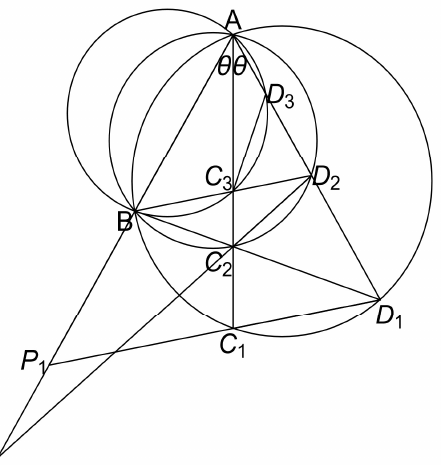
문제에 주어진 점들을 좌표평면에서 잡고 직선 AB\displaystyle \mathrm{AB}의 기울기가 양수인 경우를 생각하자. [문제 2-i]의 결과로부터 AB:ADn=2:1\displaystyle \overline{\mathrm{AB}}:\overline{\mathrm{AD}_{n}}=2:1인 경우에 선분 AB\displaystyle \mathrm{AB}와 선분 CnDn\displaystyle \mathrm{C}_{n}\mathrm{D}_{n}이 서로 평행하게 됨을 주목하자. AB:AD1=23:1\displaystyle \overline{\mathrm{AB}}:\overline{\mathrm{AD}_{1}}=\frac{2}{3}:1이므로 선분 AB\displaystyle \mathrm{AB}의 기울기는 선분 C1D1\displaystyle \mathrm{C}_{1}\mathrm{D}_{1}의 기울기보다 더 큼을 알 수 있다. (다음 그림 참조)P1\displaystyle \mathrm{P}_{1}을 직선 AB\displaystyle \mathrm{AB}와 직선 C1D1\displaystyle \mathrm{C}_{1}\mathrm{D}_{1}의 교점으로 놓고, 선분 AP1\displaystyle \mathrm{AP}_{1}의 길이를 x\displaystyle x라고 하자. 삼각형 AP1D1\displaystyle \mathrm{AP}_{1}\mathrm{D}_{1}에 코사인법칙을 적용하면, P1D1=x23x+9\displaystyle \overline{\mathrm{P}_{1}\mathrm{D}_{1}}=\sqrt{x^{2}-3x+9}를 얻는다. 점 C1\displaystyle \mathrm{C}_{1}은 선분 P1D1\displaystyle \mathrm{P}_{1}\mathrm{D}_{1}x:3\displaystyle x:3으로 내분하는 점이므로, P1C1=x23x+9xx+3\displaystyle \overline{\mathrm{P}_{1}\mathrm{C}_{1}}=\sqrt{x^{2}-3x+9}\cdot\frac{x}{x+3}이다. 이제 점 P1\displaystyle \mathrm{P}_{1}으로부터 삼각형 ABD1\displaystyle \mathrm{ABD}_{1}의 외접원에 그은 할선들의 길이 사이의 관계로부터,(x2)x=x23x+9xx+3x23x+9\displaystyle (x-2)\cdot x=\sqrt{x^{2}-3x+9}\cdot\frac{x}{x+3}\cdot\sqrt{x^{2}-3x+9}이므로 이를 정리하면, x=154\displaystyle x=\frac{15}{4}를 얻는다. 삼각형 ABD2\displaystyle \mathrm{ABD}_{2}와 삼각형 AP1D1\displaystyle \mathrm{AP}_{1}\mathrm{D}_{1}이 서로 닮아 있으므로, 비례식 AD2:3=2:154\displaystyle \overline{\mathrm{AD}_{2}}:3=2:\frac{15}{4}가 성립하고, 이로부터 AD2=85\displaystyle \overline{\mathrm{AD}_{2}}=\frac{8}{5}을 얻는다. 이제 AB:AD2=1.25:1\displaystyle \overline{\mathrm{AB}}:\overline{\mathrm{AD}_{2}}=1.25:1이므로 선분 AB\displaystyle \mathrm{AB}의 기울기는 선분 C2D2\displaystyle \mathrm{C}_{2}\mathrm{D}_{2}의 기울기보다 더 큼을 알 수 있다. 이제 점 P2\displaystyle \mathrm{P}_{2}를 직선 AB\displaystyle \mathrm{AB}와 직선 C2D2\displaystyle \mathrm{C}_{2}\mathrm{D}_{2}의 교점으로 놓고, 선분 AP2\displaystyle \mathrm{AP}_{2}의 길이를 t\displaystyle t라고 하자. 삼각형 AP2D2\displaystyle \mathrm{AP}_{2}\mathrm{D}_{2}에 코사인법칙을 적용하면, P2D2=25t240t+645\displaystyle \overline{\mathrm{P}_{2}\mathrm{D}_{2}}=\frac{\sqrt{25t^{2}-40t+64}}{5}를 얻는다. 점 C2\displaystyle \mathrm{C}_{2}은 선분 P2D2\displaystyle \mathrm{P}_{2}\mathrm{D}_{2}t:85\displaystyle t:\frac{8}{5}로 내분하는 점이므로, P2C2=25t240t+645tt+1.6\displaystyle \overline{\mathrm{P}_{2}\mathrm{C}_{2}}=\frac{\sqrt{25t^{2}-40t+64}}{5}\cdot\frac{t}{t+1.6}이다. 이제 점 P2\displaystyle \mathrm{P}_{2}으로부터 삼각형 ABD2\displaystyle \mathrm{ABD}_{2}의 외접원에 그은 할선들의 길이 사이의 관계로부터, t=245\displaystyle t=\frac{24}{5}를 얻는다. 삼각형 ABD3\displaystyle \mathrm{ABD}_{3}과 삼각형 AP2D2\displaystyle \mathrm{AP}_{2}\mathrm{D}_{2}가 서로 닮아있으므로, 비례식 AD3:85=2:245\displaystyle \overline{\mathrm{AD}_{3}}:\frac{8}{5}=2:\frac{24}{5}가 성립하고, 이로부터 AD3=23\displaystyle \overline{\mathrm{AD}_{3}}=\frac{2}{3}을 얻는다. 이제 AB:AD3=3:1\displaystyle \overline{\mathrm{AB}}:\overline{\mathrm{AD}_{3}}=3:1이므로 선분 AB\displaystyle \mathrm{AB}의 기울기는 선분 C3D3\displaystyle \mathrm{C}_{3}\mathrm{D}_{3}의 기울기보다 더 작아짐을 알 수 있다. 따라서 직선 AD1\displaystyle \mathrm{AD}_{1} 위에 점 D4\displaystyle \mathrm{D}_{4}와 점 D3\displaystyle \mathrm{D}_{3} 사이에 점 A\displaystyle \mathrm{A}가 위치하게 된다. 따라서 BADn=2π3\displaystyle \angle\mathrm{BAD}_{n}=\frac{2\pi}{3}가 되는 자연수 n\displaystyle n의 최솟값은 4이고 그때 AD3=23\displaystyle \overline{\mathrm{AD}_{3}}=\frac{2}{3}이다.답: BADn=2π3\displaystyle \angle\mathrm{BAD}_{n}=\frac{2\pi}{3}가 되는 자연수 n\displaystyle n의 최솟값: 4\displaystyle 4, AD3=23\displaystyle \overline{\mathrm{AD}_{3}}=\frac{2}{3}

점 A, B와 귀납적으로 정의된 점 C₁, C₂, C₃, D₁, D₂, D₃, 그리고 직선 AB와 직선 CₙDₙ의 교점 P₁, P₂를 여러 외접원과 함께 그린 그림.

첨삭 사례

아직 등록된 첨삭 사례가 없습니다.

질문과 답변 · 0개질문과 답변 · 고정 0개

아직 등록된 질문이 없습니다. 질문 작성은 멤버십 회원만 가능합니다.