수리논술, 이게 다다.

자연계열 I 4번

오류 제보

문제

다음 제시문을 읽고 아래 논제에 답하시오. (20점)

(가) 반지름의 길이가 r\displaystyle r, 중심각의 크기가 θ\displaystyle \theta(라디안)인 부채꼴의 넓이를 S\displaystyle S라고 하면S=12r2θ\displaystyle S=\frac12r^2\theta[출처 : 수학I 「삼각함수」](나) lim⁡θ→0sin⁡θθ=1\displaystyle \lim_{\theta\to0}\frac{\sin\theta}{\theta}=1 (단, θ\displaystyle \theta의 단위는 라디안)[출처 : 미적분 「여러 가지 함수의 미분」]

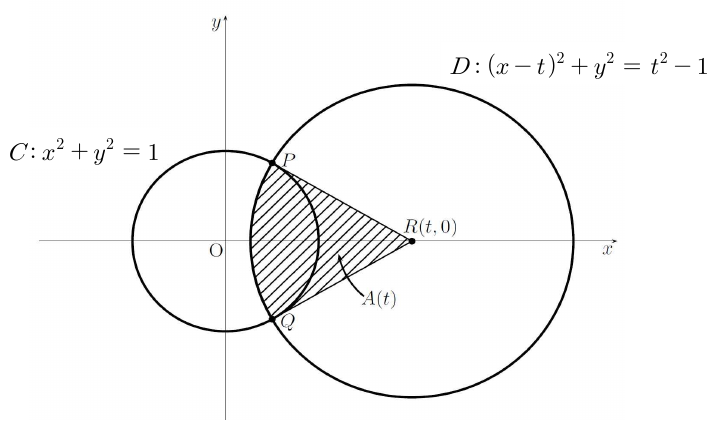
좌표평면에 원 C:x2+y2=1\displaystyle C:x^2+y^2=1과 원 D:(x−t)2+y2=t2−1\displaystyle D:(x-t)^2+y^2=t^2-1 (t>1\displaystyle t>1)이 있다. <그림 1>과 같이 두 원의 교점을 P\displaystyle P와 Q\displaystyle Q, 원 D\displaystyle D의 중심을 R\displaystyle R라고 할 때, 부채꼴 PRQ\displaystyle PRQ의 넓이를 A(t)\displaystyle A(t)라고 하자. 부채꼴 PRQ\displaystyle PRQ의 넓이의 변화율의 극한값 lim⁡t→∞dAdt\displaystyle \lim_{t\to\infty}\frac{dA}{dt}를 구하시오.

두 원 C, D와 부채꼴 PRQ
<그림 1>
해설강의 준비중
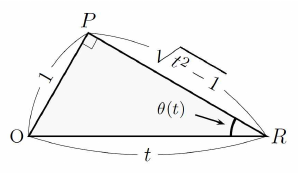
직각삼각형 PRO와 각 θ(t)
+20점 · 주어진 조건으로부터 부채꼴의 넓이를 올바른 함수로 표현하고 합성함수의 미분법을 이용하여 그 도함수를 구한 뒤, 극한을 정확하게 계산할 수 있다.

∠PRO\displaystyle \angle PRO의 크기를 θ(t)\displaystyle \theta(t)라고 하자. 삼각형 PRO\displaystyle PRO는 피타고라스의 정리에 의해 ∠OPR=90∘\displaystyle \angle OPR=90^\circ인 직각삼각형이므로, 삼각형의 변의 길이와 삼각비의 정의에 의해 다음 관계가 성립한다.sin⁡θ(t)=1t,cos⁡θ(t)=t2−1t\displaystyle \sin\theta(t)=\frac1t,\quad\cos\theta(t)=\frac{\sqrt{t^2-1}}t ………………………①부채꼴 PRQ\displaystyle PRQ의 넓이 A(t)\displaystyle A(t)는A(t)=12(t2−1)2⋅2θ(t)=(t2−1)⋅θ(t)\displaystyle A(t)=\frac12(\sqrt{t^2-1})^2\cdot2\theta(t)=(t^2-1)\cdot\theta(t)이므로 넓이의 t\displaystyle t에 대한 변화율은 다음과 같다.dAdt=2t⋅θ(t)+(t2−1)⋅dθdt\displaystyle \frac{dA}{dt}=2t\cdot\theta(t)+(t^2-1)\cdot\frac{d\theta}{dt} ………………………②또한 부등식 sin⁡θ<θ<tan⁡θ\displaystyle \sin\theta<\theta<\tan\theta (0<θ<π2\displaystyle 0<\theta<\frac\pi2)와 ①로부터1t<θ(t)<1t2−1\displaystyle \frac1t<\theta(t)<\frac1{\sqrt{t^2-1}}이고 lim⁡t→∞1t=lim⁡t→∞1t2−1=0\displaystyle \lim_{t\to\infty}\frac1t=\lim_{t\to\infty}\frac1{\sqrt{t^2-1}}=0이므로 함수의 극한의 성질에 의해 t→∞\displaystyle t\to\infty이면 θ→0\displaystyle \theta\to0이다.먼저 ②의 우변 첫째 항의 극한값은 ①에 의해 다음과 같이 계산된다.lim⁡t→∞2t⋅θ(t)=lim⁡t→∞(2sin⁡θ(t)⋅θ(t))=2⋅lim⁡θ→0(θsin⁡θ)=2\displaystyle \lim_{t\to\infty}2t\cdot\theta(t)=\lim_{t\to\infty}\left(\frac2{\sin\theta(t)}\cdot\theta(t)\right)=2\cdot\lim_{\theta\to0}\left(\frac\theta{\sin\theta}\right)=2 ……………③dθdt\displaystyle \frac{d\theta}{dt}를 구하기 위해 ①의 첫 번째 식의 양변을 미분하고 두 번째 식을 대입하면 다음과 같다.−1t2=ddtsin⁡θ(t)=cos⁡θ(t)⋅dθdt=t2−1t⋅dθdt\displaystyle -\frac1{t^2}=\frac d{dt}\sin\theta(t)=\cos\theta(t)\cdot\frac{d\theta}{dt}=\frac{\sqrt{t^2-1}}t\cdot\frac{d\theta}{dt}이로부터dθdt=−1tt2−1\displaystyle \frac{d\theta}{dt}=-\frac1{t\sqrt{t^2-1}}을 얻는다. 따라서 ②의 우변 둘째 항의 극한값을 다음과 같이 계산할 수 있다.lim⁡t→∞(t2−1)⋅dθdt=lim⁡t→∞(−(t2−1)⋅1tt2−1)=lim⁡t→∞(−t2−1t)=−1\displaystyle \lim_{t\to\infty}(t^2-1)\cdot\frac{d\theta}{dt}=\lim_{t\to\infty}\left(-(t^2-1)\cdot\frac1{t\sqrt{t^2-1}}\right)=\lim_{t\to\infty}\left(-\frac{\sqrt{t^2-1}}t\right)=-1 …………④위에서 계산한 ③과 ④로부터 넓이 A(t)\displaystyle A(t)의 변화율의 극한값은 다음과 같다.lim⁡t→∞dAdt=lim⁡t→∞(2t⋅θ(t)+(t2−1)⋅dθdt)=2−1=1\displaystyle \lim_{t\to\infty}\frac{dA}{dt}=\lim_{t\to\infty}\left(2t\cdot\theta(t)+(t^2-1)\cdot\frac{d\theta}{dt}\right)=2-1=1

첨삭 사례

아직 등록된 첨삭 사례가 없습니다.

질문과 답변 · 0개질문과 답변 · 고정 0개

아직 등록된 질문이 없습니다. 질문 작성은 멤버십 회원만 가능합니다.