수리논술, 이게 다다.

자연계열 II 2번

오류 제보

문제

다음 제시문을 읽고 아래 논제에 답하시오. (25점)

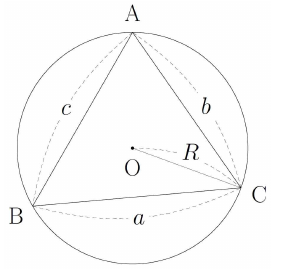
삼각형 ABC의 외접원의 반지름의 길이를 R\displaystyle R라고 하면asin⁡A=bsin⁡B=csin⁡C=2R\displaystyle \frac a{\sin A}=\frac b{\sin B}=\frac c{\sin C}=2R

외접원에 내접하는 삼각형 ABC와 반지름 R

[출처 : 수학I 「사인법칙과 코사인법칙」]

함수 f(x)\displaystyle f(x)가 구간 [−1,1]\displaystyle [-1,1]에서 다음과 같이 정의되어 있다.f(x)={1−x2(−1≤x≤0)1−x2(0<x≤1)\displaystyle f(x)=\begin{cases}1-x^2&(-1\le x\le0)\\\sqrt{1-x^2}&(0<x\le1)\end{cases}

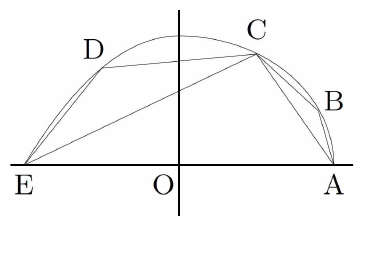
곡선 y=f(x)\displaystyle y=f(x) 위에 오각형 ABCDE의 모든 꼭짓점이 놓여 있다. 점 A의 좌표는 (1,0)\displaystyle (1,0), 점 E의 좌표는 (−1,0)\displaystyle (-1,0)이고 두 점 B, C의 x\displaystyle x좌표는 모두 양수이며 ∠ABC=150∘\displaystyle \angle\mathrm{ABC}=150^\circ이다. 이때 다음 문항에 답하시오.

(1) 삼각형 ACE의 넓이를 구하시오.

(2) 오각형 ABCDE의 넓이가 최대가 되도록 하는 꼭짓점 B, C, D의 좌표를 구하시오.

해설강의 준비중
+7.5점 · 사인법칙을 적용하여 점 C의 좌표를 구하고, 삼각형 ACE의 넓이를 구한다.

(1) 오각형 ABCDE에 두 대각선 AC, CE를 그어 오각형 ABCDE를 세 개의 삼각형 ABC, ACE, CDE로 나누자.

곡선 위의 오각형 ABCDE와 두 대각선 AC, CE

점 A,B,C가 곡선 y=1−x2\displaystyle y=\sqrt{1-x^2} (x>0\displaystyle x>0) 위에 놓여 있으므로 삼각형 ABC는 중심이 O(0,0)\displaystyle (0,0), 반지름이 1인 원에 내접한다. 그러므로 사인법칙을 적용하면AC‾sin⁡150∘=2,AC‾=1\displaystyle \frac{\overline{\mathrm{AC}}}{\sin150^\circ}=2,\quad\overline{\mathrm{AC}}=1이때, OA‾=OC‾=1\displaystyle \overline{\mathrm{OA}}=\overline{\mathrm{OC}}=1이므로, 삼각형 OAC는 세 변의 길이가 모두 1인 정삼각형이다. 따라서 C=(12,32)\displaystyle \mathrm C=\left(\frac12,\frac{\sqrt3}2\right)이고 삼각형 ACE의 넓이는12×2×32=32\displaystyle \frac12\times2\times\frac{\sqrt3}2=\frac{\sqrt3}2이다.

+17.5점 · 오각형 ABCDE의 넓이가 최대가 되게 하는 점의 좌표를 구한다.

(2) 문항 (1)에 의하여 삼각형 ACE는 고정되어 있으므로 두 삼각형 ABC, CDE의 넓이가 각각 가장 큰 값을 가질 때 오각형 ABCDE의 넓이는 최대가 된다.삼각형 ABC의 넓이는 두 점 A, C를 지나는 직선과 점 B 사이의 거리가 최대일 때 가장 큰 값을 갖는다. 호 AC 위의 점 B에서 현 AC까지의 거리는 선분 OB가 현 AC를 수직 이등분할 때 최대가 된다.C=(12,32)=(cos⁡60∘,sin⁡60∘)\displaystyle \mathrm C=\left(\frac12,\frac{\sqrt3}2\right)=(\cos60^\circ,\sin60^\circ)이므로 B의 좌표는B=(cos⁡30∘,sin⁡30∘)=(32,12)\displaystyle \mathrm B=(\cos30^\circ,\sin30^\circ)=\left(\frac{\sqrt3}2,\frac12\right)또한, 삼각형 CDE의 넓이가 최대가 되기 위해서는 두 점 C,E를 지나는 직선과 점 D 사이의 거리가 최대가 되어야 한다.함수 f(x)\displaystyle f(x)는 x=0\displaystyle x=0에서lim⁡x→0+f(x)−1x=lim⁡x→0+1−x2−1x=lim⁡x→0+−x1−x2+1=0\displaystyle \lim_{x\to0^+}\frac{f(x)-1}x=\lim_{x\to0^+}\frac{\sqrt{1-x^2}-1}x=\lim_{x\to0^+}\frac{-x}{\sqrt{1-x^2}+1}=0lim⁡x→0−f(x)−1x=lim⁡x→0−(1−x2)−1x=lim⁡x→0−(−x)=0\displaystyle \lim_{x\to0^-}\frac{f(x)-1}x=\lim_{x\to0^-}\frac{(1-x^2)-1}x=\lim_{x\to0^-}(-x)=0이므로, f(x)\displaystyle f(x)는 구간 (−1,1)\displaystyle (-1,1)에서 미분가능하고f′(x)={−2x(−1<x≤0)−x1−x2(0<x<1)\displaystyle f^{\prime}(x)=\begin{cases}-2x&(-1<x\le0)\\-\frac x{\sqrt{1-x^2}}&(0<x<1)\end{cases}따라서, 점 D에서의 접선과 두 점 C,E를 지나는 직선이 평행할 때 삼각형 CDE의 넓이는 최대가 된다.두 점 C,E를 지나는 직선의 기울기가 32−012−(−1)=13\displaystyle \frac{\frac{\sqrt3}2-0}{\frac12-(-1)}=\frac1{\sqrt3}이므로, 점 D의 x\displaystyle x좌표는 f′(x)=13\displaystyle f^{\prime}(x)=\frac1{\sqrt3}을 만족하는 값이다. f′(x)>0\displaystyle f^{\prime}(x)>0이기 위해서는 x<0\displaystyle x<0이어야 하므로f′(x)=−2x=13,x=−123\displaystyle f^{\prime}(x)=-2x=\frac1{\sqrt3},\quad x=-\frac1{2\sqrt3}따라서 점 D의 좌표는 (−123,1112)\displaystyle \left(-\frac1{2\sqrt3},\frac{11}{12}\right)이다.이로부터 오각형 ABCDE의 넓이가 최대가 되도록 하는 꼭짓점 B, C, D의 좌표는B(32,12), C(12,32), D(−36,1112)\displaystyle \mathrm B\left(\frac{\sqrt3}2,\frac12\right),\ \mathrm C\left(\frac12,\frac{\sqrt3}2\right),\ \mathrm D\left(-\frac{\sqrt3}6,\frac{11}{12}\right)이다.

첨삭 사례

아직 등록된 첨삭 사례가 없습니다.

질문과 답변 · 0개질문과 답변 · 고정 0개

아직 등록된 질문이 없습니다. 질문 작성은 멤버십 회원만 가능합니다.