수리논술, 배움에서 논증의 완성까지.

자연계열 (오후) 4번

문제

🔒
짧은 시간에 너무 많은 문제를 여셔서 열람을 잠시 제한했습니다. 잠시 후 다시 시도하시거나 로그인해 주세요.
해설강의 준비중

(1) 선분 ED\displaystyle \mathrm{ED}의 길이를 구하시오. (8점)

(풀이)

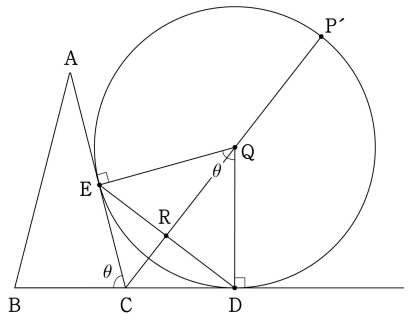
중심 Q, 접점 E와 D, 넓이가 최대인 P′ 및 보조선
+4점 · cosθ=14\displaystyle \cos\theta=\frac14을 구할 수 있다. (단, ACB=θ\displaystyle \angle\mathrm{ACB}=\theta) (또는 cos(πθ)=14\displaystyle \cos(\pi-\theta)=-\frac14을 구할 수 있다.) +4점 · ED=102\displaystyle \overline{\mathrm{ED}}=\frac{\sqrt{10}}2을 구할 수 있다.

위의 그림과 같이 ACB=θ\displaystyle \angle\mathrm{ACB}=\theta라 하자. 이등변삼각형 ABC\displaystyle \mathrm{ABC}의 각 변의 길이가 AB=AC=2\displaystyle \overline{\mathrm{AB}}=\overline{\mathrm{AC}}=2, BC=1\displaystyle \overline{\mathrm{BC}}=1이므로, cosθ=14\displaystyle \cos\theta=\frac14이다. 또한, 점 D\displaystyle \mathrm{D}는 선분 BC\displaystyle \mathrm{BC}2:1\displaystyle 2:1로 외분하는 점이므로 CD=1\displaystyle \overline{\mathrm{CD}}=1이고, CD=CE\displaystyle \overline{\mathrm{CD}}=\overline{\mathrm{CE}}이므로 CE=1\displaystyle \overline{\mathrm{CE}}=1이다. 삼각형 CDE\displaystyle \mathrm{CDE}에 대하여 코사인법칙을 적용하면ED2=CE2+CD22×CD×CE×cos(πθ)=1+12×1×1×(14)=52\displaystyle \begin{aligned}\overline{\mathrm{ED}}^2&=\overline{\mathrm{CE}}^2+\overline{\mathrm{CD}}^2-2\times\overline{CD}\times\overline{CE}\times\cos(\pi-\theta)\\&=1+1-2\times1\times1\times\left(-\frac14\right)\\&=\frac52\end{aligned}이다. 따라서, 선분 ED\displaystyle \mathrm{ED}의 길이는 102\displaystyle \frac{\sqrt{10}}2이다.

(2) 원 C1\displaystyle C_1 위의 임의의 점 P\displaystyle \mathrm{P}에 대하여 삼각형 PED\displaystyle \mathrm{PED}의 넓이의 최댓값을 구하시오. (12점)

+4점 · 원 C1\displaystyle C_1의 반지름 EQ=153\displaystyle \overline{\mathrm{EQ}}=\frac{\sqrt{15}}3를 구할 수 있다. +4점 · QR=5612\displaystyle \overline{\mathrm{QR}}=\frac{5\sqrt6}{12}을 구할 수 있다. +4점 · 삼각형 PED\displaystyle \mathrm{PED}의 넓이의 최댓값인 51524+5612\displaystyle \frac{5\sqrt{15}}{24}+\frac{5\sqrt6}{12}을 구할 수 있다.

(풀이) 원 C1\displaystyle C_1의 중심을 Q\displaystyle \mathrm{Q}라 하자. 두 삼각형 QEC\displaystyle \mathrm{QEC}QCD\displaystyle \mathrm{QCD}가 직각삼각형이므로, 네 점 Q\displaystyle \mathrm{Q}, E\displaystyle \mathrm{E}, C\displaystyle \mathrm{C}, D\displaystyle \mathrm{D}는 지름이 QC\displaystyle \overline{\mathrm{QC}}인 원 위에 있다. 이등변삼각형 ABC\displaystyle \mathrm{ABC}의 각 변의 길이가 AB=AC=2\displaystyle \overline{\mathrm{AB}}=\overline{\mathrm{AC}}=2, BC=1\displaystyle \overline{\mathrm{BC}}=1이므로, sinθ=154\displaystyle \sin\theta=\frac{\sqrt{15}}4이다. DQE=θ\displaystyle \angle\mathrm{DQE}=\theta이므로, 삼각형 QED\displaystyle \mathrm{QED}에 대하여 사인법칙을 적용하면QC=EDsinθ=263\displaystyle \overline{\mathrm{QC}}=\frac{\overline{\mathrm{ED}}}{\sin\theta}=\frac{2\sqrt6}{3}이고, 직각삼각형 QEC\displaystyle \mathrm{QEC}에 대하여 EQ2=QC2EC2\displaystyle \overline{\mathrm{EQ}}^2=\overline{\mathrm{QC}}^2-\overline{\mathrm{EC}}^2이므로 EQ=153\displaystyle \overline{\mathrm{EQ}}=\frac{\sqrt{15}}3이다. 직선 QC\displaystyle \mathrm{QC}와 원 C1\displaystyle C_1가 만나는 점 중에 점 C\displaystyle \mathrm{C}와의 거리가 가장 먼 점을 P\displaystyle \mathrm{P}', 선분 ED\displaystyle \mathrm{ED}와 선분 QC\displaystyle \mathrm{QC}가 만나는 점을 R\displaystyle \mathrm{R}이라 할 때,ER=12ED=104\displaystyle \overline{\mathrm{ER}}=\frac12\overline{\mathrm{ED}}=\frac{\sqrt{10}}4이고, 직각삼각형 EQR\displaystyle \mathrm{EQR}에 대하여 QR2=EQ2ER2\displaystyle \overline{\mathrm{QR}}^2=\overline{\mathrm{EQ}}^2-\overline{\mathrm{ER}}^2이므로 QR=5612\displaystyle \overline{\mathrm{QR}}=\frac{5\sqrt6}{12}이다. 원 C1\displaystyle C_1 위의 임의의 점 P\displaystyle \mathrm{P}가 점 P\displaystyle \mathrm{P}'에 위치할 때, 삼각형 PED\displaystyle \mathrm{PED}의 넓이가 최대이고, PQ=EQ=153\displaystyle \overline{\mathrm{P}'\mathrm{Q}}=\overline{\mathrm{EQ}}=\frac{\sqrt{15}}3이므로, 삼각형 PED\displaystyle \mathrm{P}'\mathrm{ED}의 넓이는ΔPED=12×ED×(QR+PQ)=51524+5612\displaystyle \begin{aligned}\Delta\mathrm{P}'\mathrm{ED}&=\frac12\times\overline{\mathrm{ED}}\times(\overline{\mathrm{QR}}+\overline{\mathrm{P}'\mathrm{Q}})\\&=\frac{5\sqrt{15}}{24}+\frac{5\sqrt6}{12}\end{aligned}이다. 따라서, 문제에서 구하고자 하는 삼각형 PED\displaystyle \mathrm{PED}의 넓이의 최댓값은 51524+5612\displaystyle \frac{5\sqrt{15}}{24}+\frac{5\sqrt6}{12}이다.

첨삭 사례

아직 등록된 첨삭 사례가 없습니다.

질문과 답변 · 0개질문과 답변 · 고정 0개

아직 등록된 질문이 없습니다. 질문 작성은 멤버십 회원만 가능합니다.