+5점 · A B → ⋅ A C → = O B → ⋅ O C → − ( O B → + O C → ) ⋅ O A → + 1 \displaystyle \overrightarrow{\mathrm{AB}}\cdot\overrightarrow{\mathrm{AC}}=\overrightarrow{\mathrm{OB}}\cdot\overrightarrow{\mathrm{OC}}-\left(\overrightarrow{\mathrm{OB}}+\overrightarrow{\mathrm{OC}}\right)\cdot\overrightarrow{\mathrm{OA}}+1 AB ⋅ AC = OB ⋅ OC − ( OB + OC ) ⋅ OA + 1 원의 중심을 O \displaystyle \mathrm{O} O A B → ⋅ A C → = ( O B → − O A → ) ⋅ ( O C → − O A → ) = O B → ⋅ O C → − ( O B → + O C → ) ⋅ O A → + O A → ⋅ O A → = O B → ⋅ O C → − ( O B → + O C → ) ⋅ O A → + 1 \displaystyle \begin{aligned}\overrightarrow{\mathrm{AB}}\cdot\overrightarrow{\mathrm{AC}}&=\left(\overrightarrow{\mathrm{OB}}-\overrightarrow{\mathrm{OA}}\right)\cdot\left(\overrightarrow{\mathrm{OC}}-\overrightarrow{\mathrm{OA}}\right)\\&=\overrightarrow{\mathrm{OB}}\cdot\overrightarrow{\mathrm{OC}}-\left(\overrightarrow{\mathrm{OB}}+\overrightarrow{\mathrm{OC}}\right)\cdot\overrightarrow{\mathrm{OA}}+\overrightarrow{\mathrm{OA}}\cdot\overrightarrow{\mathrm{OA}}\\&=\overrightarrow{\mathrm{OB}}\cdot\overrightarrow{\mathrm{OC}}-\left(\overrightarrow{\mathrm{OB}}+\overrightarrow{\mathrm{OC}}\right)\cdot\overrightarrow{\mathrm{OA}}+1\end{aligned} AB ⋅ AC = ( OB − OA ) ⋅ ( OC − OA ) = OB ⋅ OC − ( OB + OC ) ⋅ OA + OA ⋅ OA = OB ⋅ OC − ( OB + OC ) ⋅ OA + 1
두 벡터 O B → \displaystyle \overrightarrow{\mathrm{OB}} OB O C → \displaystyle \overrightarrow{\mathrm{OC}} OC θ ( 0 ≤ θ ≤ π ) \displaystyle \theta(0\le\theta\le\pi) θ ( 0 ≤ θ ≤ π ) ∣ O B → + O C → ∣ 2 = ( O B → + O C → ) ⋅ ( O B → + O C → ) = ∣ O B → ∣ 2 + ∣ O C → ∣ 2 + 2 O B → ⋅ O C → = ∣ O B → ∣ 2 + ∣ O C → ∣ 2 + 2 ∣ O B → ∣ ∣ O C → ∣ cos θ = 1 + 1 + 2 cos θ = 2 + 2 cos θ = 4 cos 2 θ 2 \displaystyle \begin{aligned}\left|\overrightarrow{\mathrm{OB}}+\overrightarrow{\mathrm{OC}}\right|^{2}&=\left(\overrightarrow{\mathrm{OB}}+\overrightarrow{\mathrm{OC}}\right)\cdot\left(\overrightarrow{\mathrm{OB}}+\overrightarrow{\mathrm{OC}}\right)\\&=\left|\overrightarrow{\mathrm{OB}}\right|^{2}+\left|\overrightarrow{\mathrm{OC}}\right|^{2}+2\overrightarrow{\mathrm{OB}}\cdot\overrightarrow{\mathrm{OC}}\\&=\left|\overrightarrow{\mathrm{OB}}\right|^{2}+\left|\overrightarrow{\mathrm{OC}}\right|^{2}+2\left|\overrightarrow{\mathrm{OB}}\right|\left|\overrightarrow{\mathrm{OC}}\right|\cos\theta\\&=1+1+2\cos\theta=2+2\cos\theta=4\cos^{2}\frac{\theta}{2}\end{aligned} OB + OC 2 = ( OB + OC ) ⋅ ( OB + OC ) = OB 2 + OC 2 + 2 OB ⋅ OC = OB 2 + OC 2 + 2 OB OC cos θ = 1 + 1 + 2 cos θ = 2 + 2 cos θ = 4 cos 2 2 θ
+5점 · cos ϕ = 1 ( ϕ = 0 ) \displaystyle \cos\phi=1(\phi=0) cos ϕ = 1 ( ϕ = 0 ) 따라서 ∣ O B → + O C → ∣ = 2 cos θ 2 \displaystyle \left|\overrightarrow{\mathrm{OB}}+\overrightarrow{\mathrm{OC}}\right|=2\cos\frac{\theta}{2} OB + OC = 2 cos 2 θ O B → + O C → \displaystyle \overrightarrow{\mathrm{OB}}+\overrightarrow{\mathrm{OC}} OB + OC O A → \displaystyle \overrightarrow{\mathrm{OA}} OA ϕ ( 0 ≤ ϕ ≤ π ) \displaystyle \phi(0\le\phi\le\pi) ϕ ( 0 ≤ ϕ ≤ π ) Note. 크기가 0 \displaystyle 0 0 영벡터 두 벡터가 이루는 각 θ \displaystyle \theta θ 0 ≤ θ ≤ π \displaystyle 0\le\theta\le\pi 0 ≤ θ ≤ π Caution. 벡터에 관한 정의나 성질을 이용할 때는 영벡터에도 적용할 수 있는지 확인해야 한다 : 대학 답안은 O B → + O C → \displaystyle \overrightarrow{\mathrm{OB}}+\overrightarrow{\mathrm{OC}} OB + OC O A → \displaystyle \overrightarrow{\mathrm{OA}} OA ϕ \displaystyle \phi ϕ O B → + O C → = 0 \displaystyle \overrightarrow{\mathrm{OB}}+\overrightarrow{\mathrm{OC}}=\mathbf0 OB + OC = 0 ϕ \displaystyle \phi ϕ A B → ⋅ A C → = 0 \displaystyle \overrightarrow{\mathrm{AB}}\cdot\overrightarrow{\mathrm{AC}}=0 AB ⋅ AC = 0 − 1 2 \displaystyle -\frac12 − 2 1 ( O B → + O C → ) ⋅ O A → = ∣ O B → + O C → ∣ ∣ O A → ∣ cos ϕ = 2 cos θ 2 cos ϕ \displaystyle \left(\overrightarrow{\mathrm{OB}}+\overrightarrow{\mathrm{OC}}\right)\cdot\overrightarrow{\mathrm{OA}}=\left|\overrightarrow{\mathrm{OB}}+\overrightarrow{\mathrm{OC}}\right|\left|\overrightarrow{\mathrm{OA}}\right|\cos\phi=2\cos\frac{\theta}{2}\cos\phi ( OB + OC ) ⋅ OA = OB + OC OA cos ϕ = 2 cos 2 θ cos ϕ 이고 cos θ 2 ≥ 0 \displaystyle \cos\frac{\theta}{2}\ge 0 cos 2 θ ≥ 0 A B → ⋅ A C → = O B → ⋅ O C → − ( O B → + O C → ) ⋅ O A → + 1 = cos θ − 2 cos θ 2 cos ϕ + 1 \displaystyle \overrightarrow{\mathrm{AB}}\cdot\overrightarrow{\mathrm{AC}}=\overrightarrow{\mathrm{OB}}\cdot\overrightarrow{\mathrm{OC}}-\left(\overrightarrow{\mathrm{OB}}+\overrightarrow{\mathrm{OC}}\right)\cdot\overrightarrow{\mathrm{OA}}+1=\cos\theta-2\cos\frac{\theta}{2}\cos\phi+1 AB ⋅ AC = OB ⋅ OC − ( OB + OC ) ⋅ OA + 1 = cos θ − 2 cos 2 θ cos ϕ + 1 cos ϕ = 1 ( ϕ = 0 ) \displaystyle \cos\phi=1(\phi=0) cos ϕ = 1 ( ϕ = 0 )
+3점 · 내적의 최솟값 − 1 2 \displaystyle -\frac{1}{2} − 2 1 ϕ = 0 \displaystyle \phi=0 ϕ = 0 A B → ⋅ A C → \displaystyle \overrightarrow{\mathrm{AB}}\cdot\overrightarrow{\mathrm{AC}} AB ⋅ AC A B → ⋅ A C → = cos θ − 2 cos θ 2 + 1 = 2 ( cos 2 θ 2 − cos θ 2 ) \displaystyle \overrightarrow{\mathrm{AB}}\cdot\overrightarrow{\mathrm{AC}}=\cos\theta-2\cos\frac{\theta}{2}+1=2\left(\cos^{2}\frac{\theta}{2}-\cos\frac{\theta}{2}\right) AB ⋅ AC = cos θ − 2 cos 2 θ + 1 = 2 ( cos 2 2 θ − cos 2 θ ) 이고 cos θ 2 = 1 2 ( θ = 2 π 3 ) \displaystyle \cos\frac{\theta}{2}=\frac{1}{2}\left(\theta=\frac{2\pi}{3}\right) cos 2 θ = 2 1 ( θ = 3 2 π ) − 1 2 \displaystyle -\frac{1}{2} − 2 1
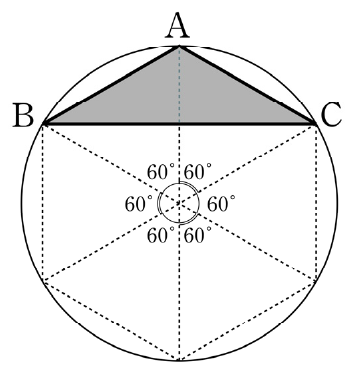
+2점 · 삼각형 A B C \displaystyle \mathrm{ABC} ABC 3 4 \displaystyle \frac{\sqrt{3}}{4} 4 3 이때, 오른쪽 그림과 같이 A B ‾ = A C ‾ = 1 \displaystyle \overline{\mathrm{AB}}=\overline{\mathrm{AC}}=1 AB = AC = 1 ∠ B A C = 2 π 3 \displaystyle \angle\mathrm{BAC}=\frac{2\pi}{3} ∠ BAC = 3 2 π △ A B C = 1 2 × A B ‾ × A C ‾ × sin ( ∠ B A C ) = 3 4 \displaystyle \triangle\mathrm{ABC}=\frac{1}{2}\times\overline{\mathrm{AB}}\times\overline{\mathrm{AC}}\times\sin(\angle\mathrm{BAC})=\frac{\sqrt{3}}{4} △ ABC = 2 1 × AB × AC × sin ( ∠ BAC ) = 4 3
※ 논리 전개 과정이 맞으면 답이 틀리더라도 1 \displaystyle 1 1 2 \displaystyle 2 2
※ 채점자는 답안의 완성도에 따라 − 0.5 \displaystyle -0.5 − 0.5 + 0.5 \displaystyle +0.5 + 0.5
 수리논술, 이게 다다.